The Steeping

Memoirs & field notes · Est. 1943

The collected memoirs

Dr Scion Sarma — chemist of the laboratory, the chemical trade and the tea leaf — recalls a life's work one story at a time. Each memoir is set with its plates, read aloud, and talked over in Odia and Bengali.

About the author →

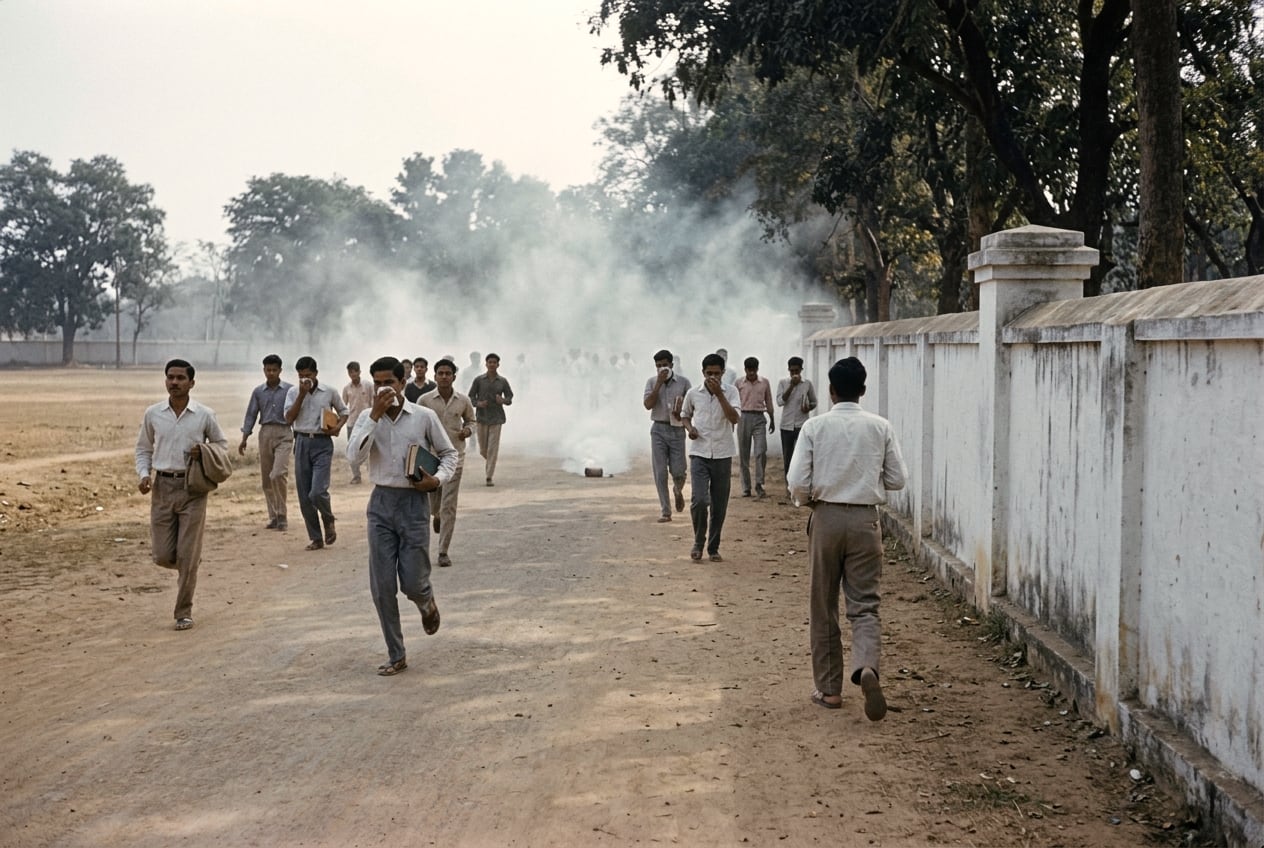
A dusty open road in Cuttack under the flat white light of a January noon. Along the right-hand side runs a low whitewashed boundary wall, waist height and flat-capped with squared piers, receding into the distance with mature trees behind it; the left of the picture is open dusty ground with distant trees and no building on it. In the middle distance a low pall of pale tear-gas smoke drifts across the road, rising from a small canister lying on the ground. Between it and the camera a scattered group of about a dozen young college-age men in full-length trousers and plain shirts hurry and run away from the smoke, spread across the road at different distances; several hold a hand over the nose and mouth, one carries books under an arm and another a cloth bag, and one man nearer the wall is seen from behind. Nobody else is present.

PortraitsCuttack — 1 January 1956

The silent murder of the kendu leaf agitation

In January 1956, the students of Cuttack launched a spirited agitation demanding the inclusion of Seraikela and Kharsawan in the then State of Orissa. On one fateful day, the police dispersed the demonstrators with tear gas and opened fire. Sunil De was killed. He was no political activist, but merely an onlooker like us. The agitation eventually faded as political priorities changed. Yet Sunil De's death remains a poignant reminder of the price ordinary people sometimes pay in public movements, while political agendas shift like sands with time.

Read aloud · 8 minDiscussion in Odia · 20 minDiscussion in Bengali · 21 min

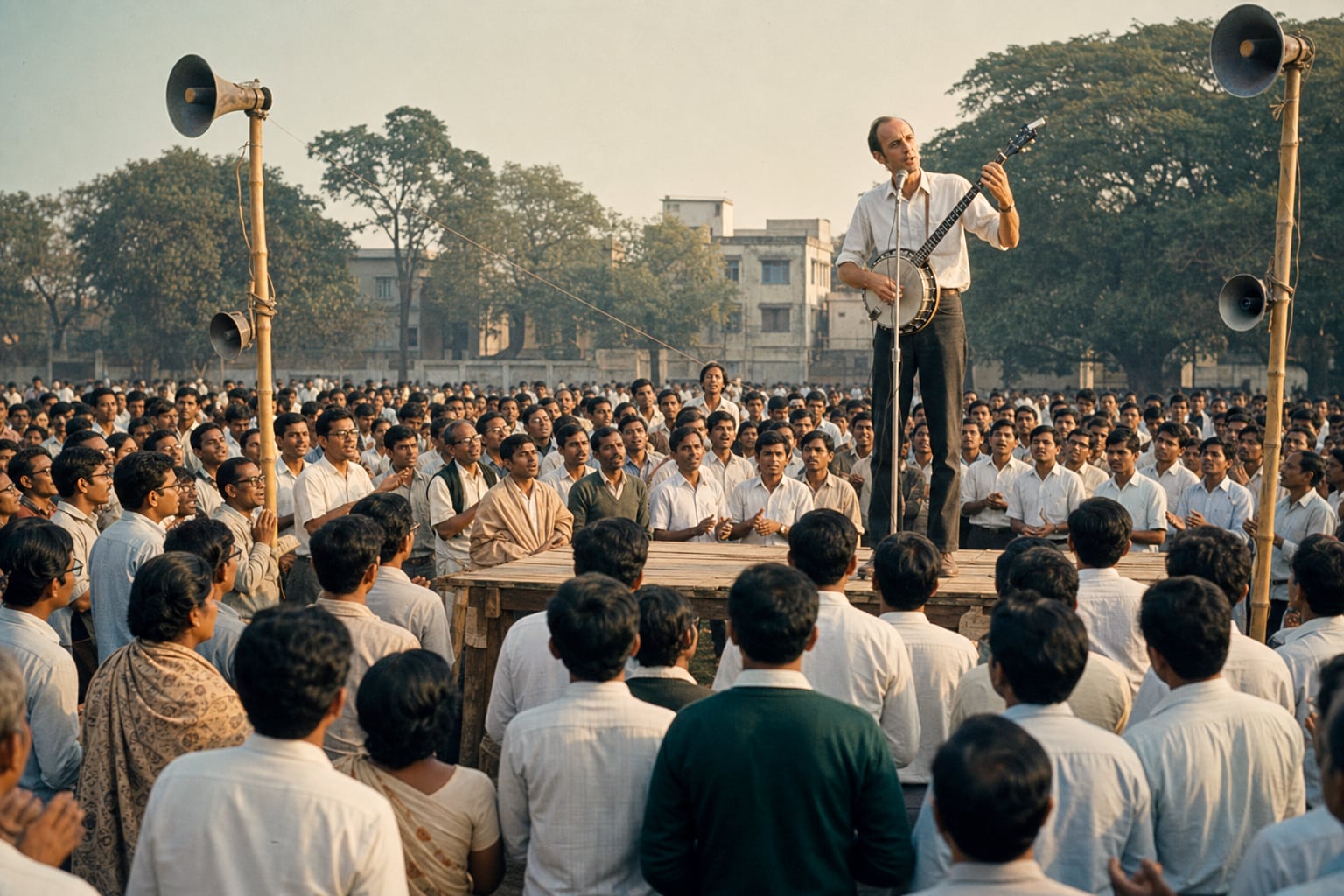
Seen from within a dense crowd on an open maidan in soft winter light, a tall, lanky man with receding hair, in a plain shirt with rolled sleeves, stands on a low makeshift stage playing a long-necked banjo at a single microphone; loudspeaker horns are lashed to bamboo poles, young men in white shirts and a few older listeners press close around the stage, some clapping time, and the trees and low buildings of 1960s Calcutta close the scene.

PortraitsCalcutta — 1 December 1963

The Banjo that Defended Justice

In December 1963, a shortcut across the Park Circus Maidan on the way to a Calcutta hospital led him into a crowd around a makeshift stage, where a tall, lanky foreigner with a long-necked banjo — a name he heard that day for the first time — had a sea of young Calcuttans singing "We Shall Overcome."

Read aloud · 5 min

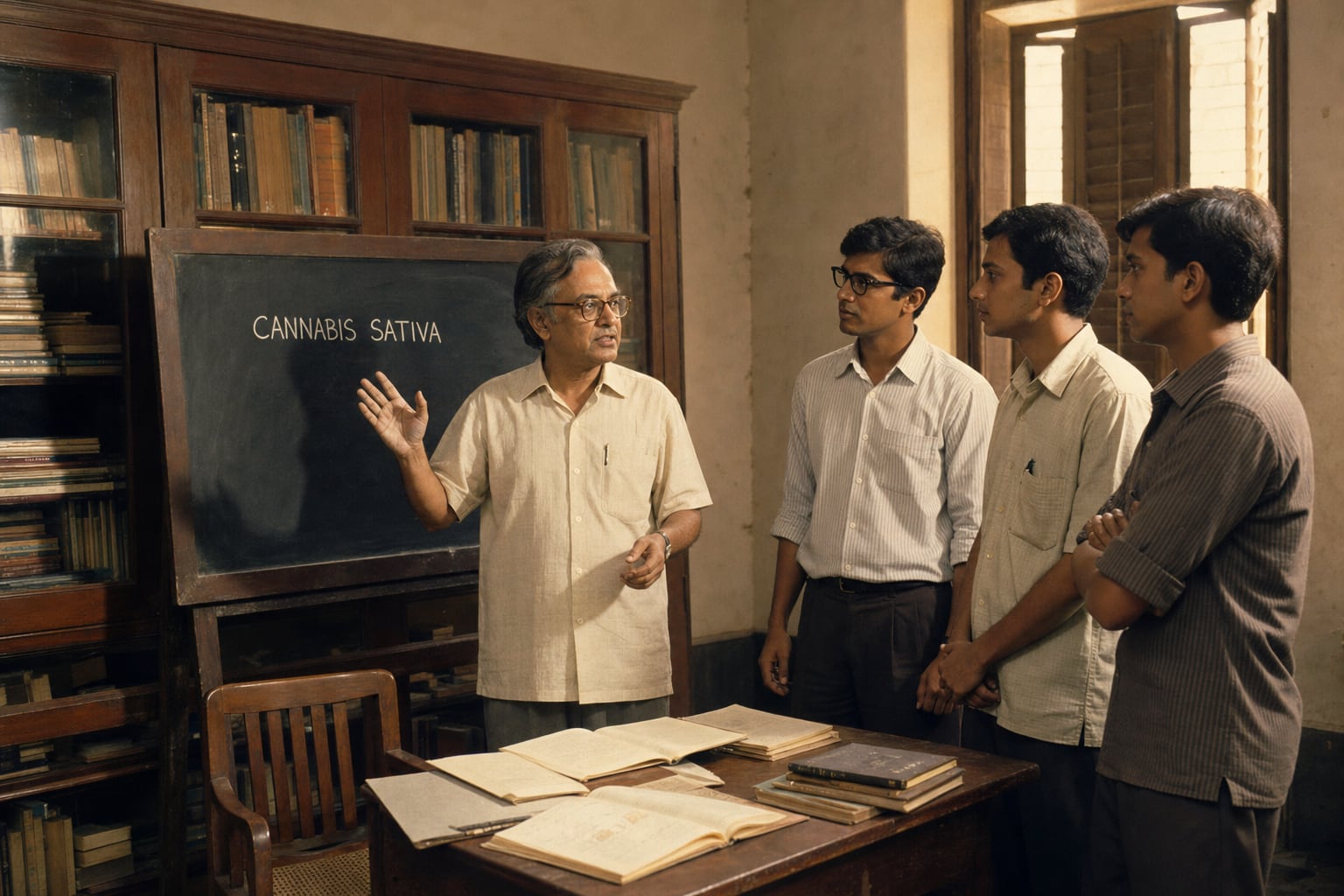
A middle-aged Bengali chemistry professor in wire-rimmed glasses turns from a small black chalkboard reading 'Cannabis sativa', one hand raised mid-explanation, while three young Indian research fellows stand and listen; a cupboard of books rises behind him and his chair and a table of scattered notebooks sit before the board in a sunlit 1964 university chemistry room.

The LaboratoryKharagpur — 1 January 1964

My introduction to the chemistry of bliss

In 1964, at IIT Kharagpur, a research fellow overdosed on bhang at a Holi celebration. His research guide, Dr Achintya Kamal Sen, instead of rebuking him for his absence from the laboratory the next day, introduced him thoroughly to the newly isolated active component of the leaf that causes hallucinations. A lesson that lingered and culminated in a meeting with the inventor of anandamide, the body's own molecule that causes bliss, three decades later.

Read aloud · 15 minDiscussion in Bengali · 21 min

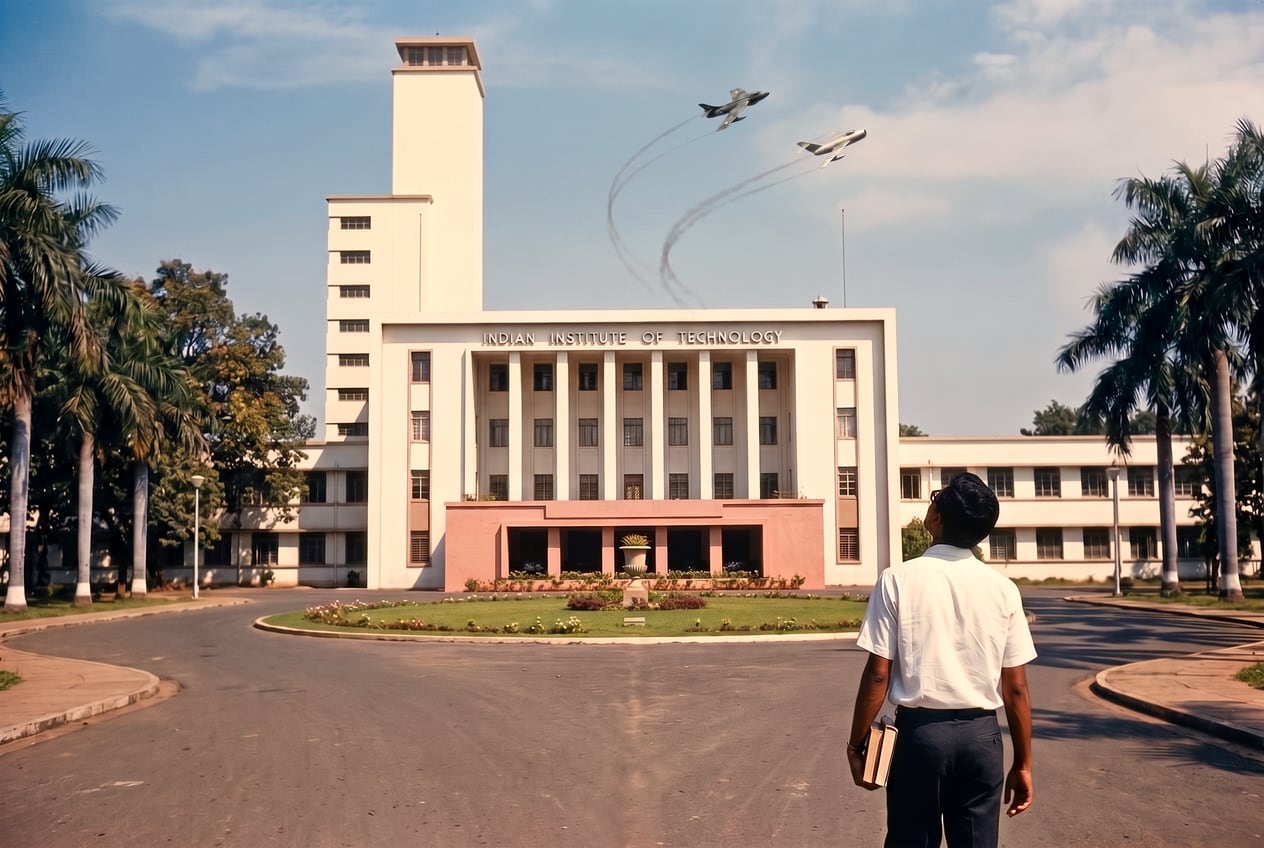
Seen from behind on a dry, empty avenue, a young man in a white collared shirt and dark trousers walks alone with two books under one arm, his head raised to the sky; his face is not visible. Ahead of him stands the main building of the Indian Institute of Technology at Kharagpur — a tall, flat-topped white tower rising beside a broad symmetrical white front of seven slender full-height piers with narrow windows recessed between them, the words INDIAN INSTITUTE OF TECHNOLOGY in spaced metal capitals across the band above them, and a low pink-faced entrance porch beneath. A circular lawn with an ornamental urn at its centre lies before it and the road curves around, with tall palms at either side. Small and high above the building, two swept-wing jet fighters are turning hard, banked over with one on the other's tail — the chasing aircraft dark, the chased one bare silver — their thin smoke trails curving and looping across the sky behind them.

PortraitsKharagpur — 7 September 1965

The dogfight over Kharagpur

On the morning of 7 September 1965, a research fellow walking back from the library at IIT Kharagpur looked up to see one jet in furious pursuit of another — and the following Sunday sat down to lunch at Kalaikunda with the Hunter pilot who had taken on four Pakistani Sabres, split from his wingman against every rule of air combat, and kept the bombs off the campus.

Read aloud · 14 min

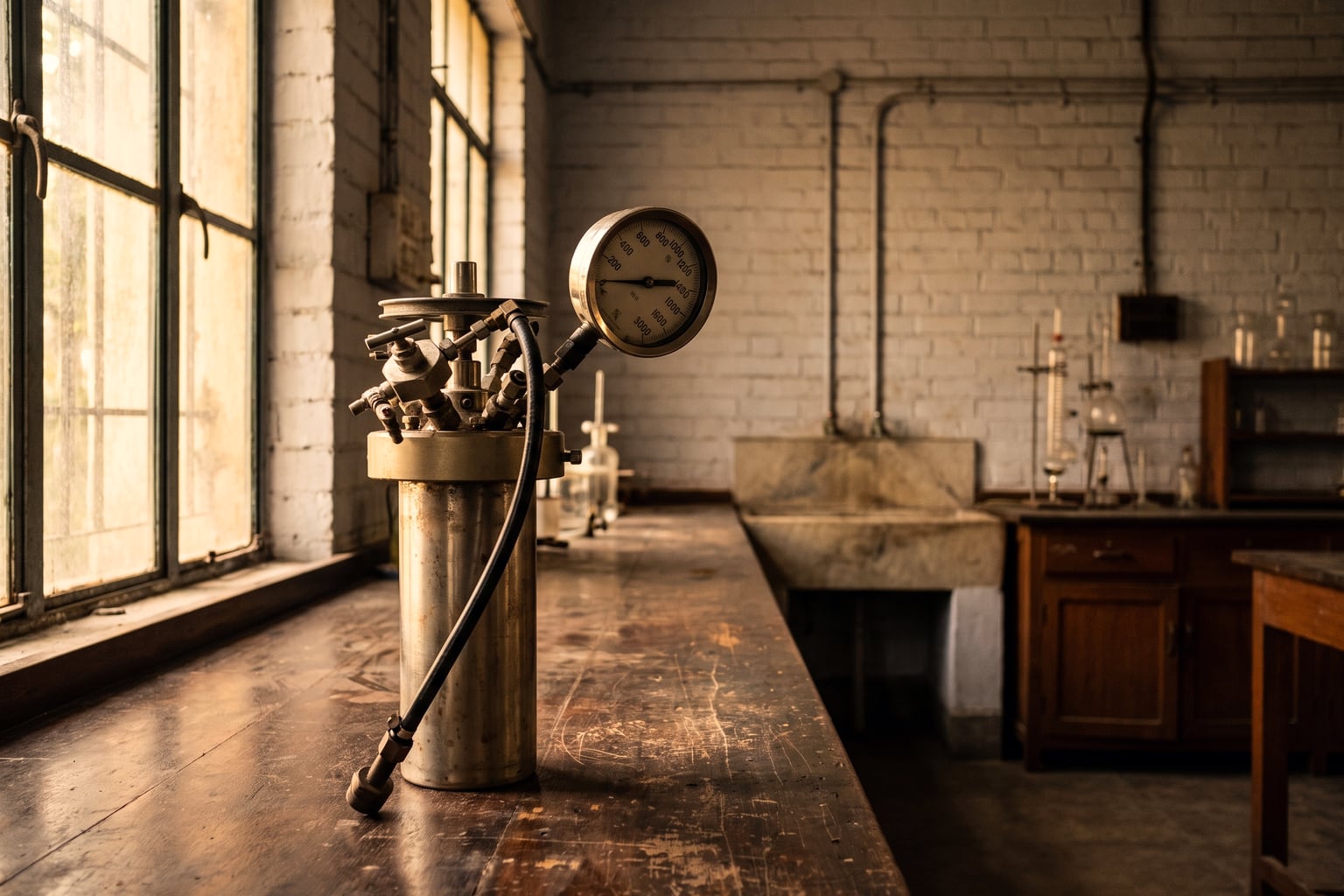
A small high-pressure reactor standing on a scarred dark wooden laboratory bench beside a tall window, in an otherwise empty room. It is a plain steel cylinder about the height of a forearm, its circular head clamped down by a ring of bolts around a raised flange, with a small spoked handwheel lying flat on top and a cluster of little valves and unions beside it. One large round pressure gauge stands up on a bracket to the right of the head, and a black flexible hose loops down from the head to a fitting at the foot of the vessel. Behind it, out of focus, are the rest of the bench, a long stone sink, glassware on a wooden dresser, whitewashed brick walls and an overhead run of pipe. Nobody is in the room.

The LaboratoryKharagpur — 1 January 1966

The forgotten achievement

At the Chemistry Laboratory at IIT Kharagpur, a young researcher displayed extraordinary courage and ingenuity by designing and fabricating his own high-pressure equipment and then risking his life to conduct its first trial. He mastered a difficult frontier of experimental chemistry, yet circumstances took him away from the laboratory. The experiment survived in my memory, but the researcher who dared to perform it was largely forgotten.

Read aloud · 15 min

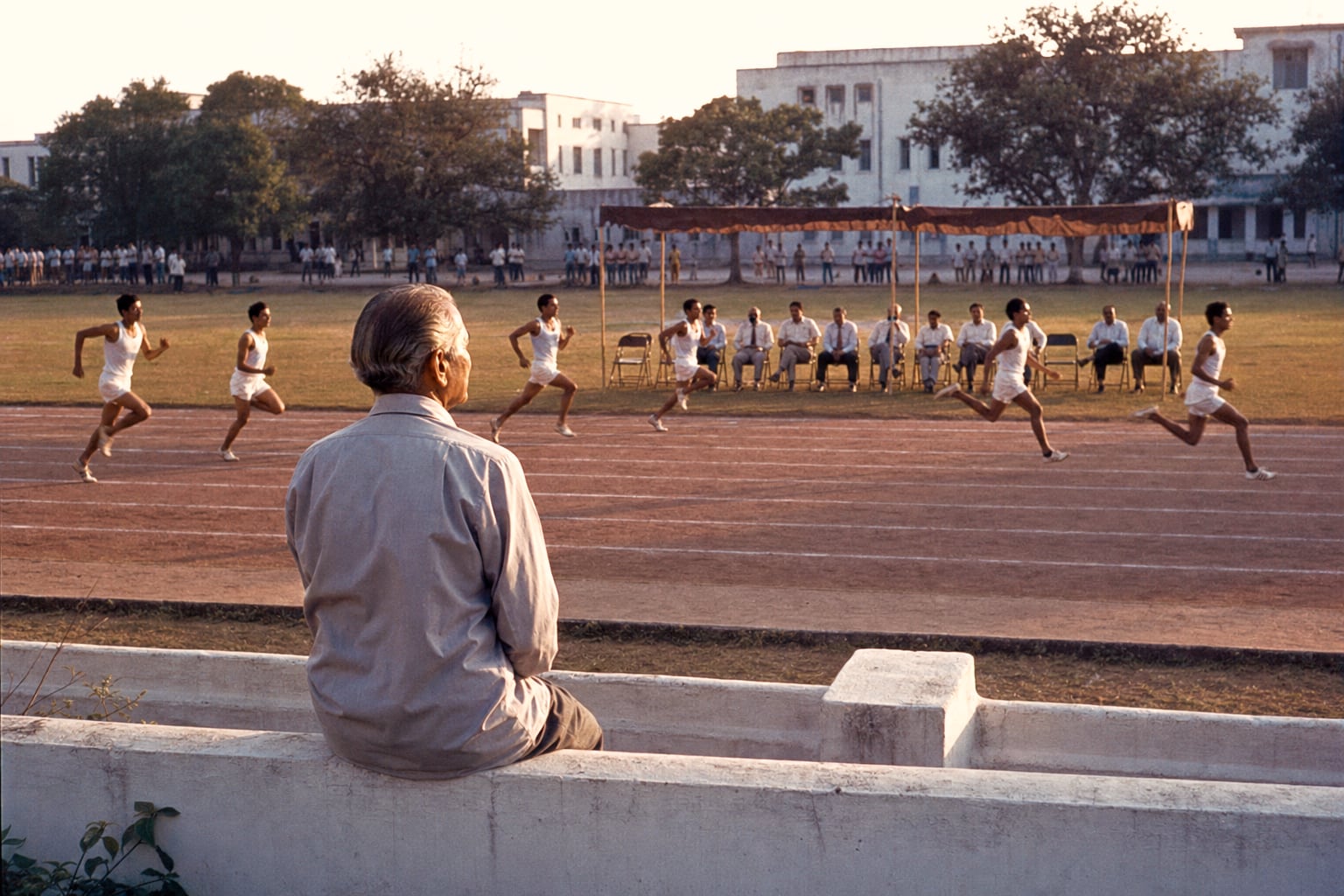
Seen from behind, a lean, slightly built elderly man with grey hair combed straight back sits alone on a low whitewashed wall in a light grey shirt, watching a sprint race pass left to right along the lanes of a red cinder track; beyond the far edge a long row of masters and officials sits beneath a shamiana awning facing the track, students stand in knots on the grass, and a pale college building rises among tall trees in late golden light.

PortraitsCuttack — 1 January 1969

Dhyan Chand in Cuttack

In January 1969, early in a coaching assignment that had brought him to Cuttack, Major Dhyan Chand — the Wizard of Hockey — sat all but unrecognised on a college wall, watching the sports day, until an old student of the college knew his face and had the legend brought to the dais.

Read aloud · 14 min

…and 3 more in the archive →


বিজ্ঞান ও কাব্য · science and poetry

The Laboratory (2)Portraits (5)In Transit (2)

Browse the archive