In Transit · A management lessonOn the Kalka Mail — 5 October 1971
A helpful subordinate
On the Kalka Mail out of Old Delhi Railway Station, in the autumn of 1971, a Sikh intelligence officer in mufti recounts how a disobedient subordinate spared him a humiliation — and hands a chemist, a week into his first job in industry, the management lesson of a lifetime.
The reading couldn’t load. Download it instead.
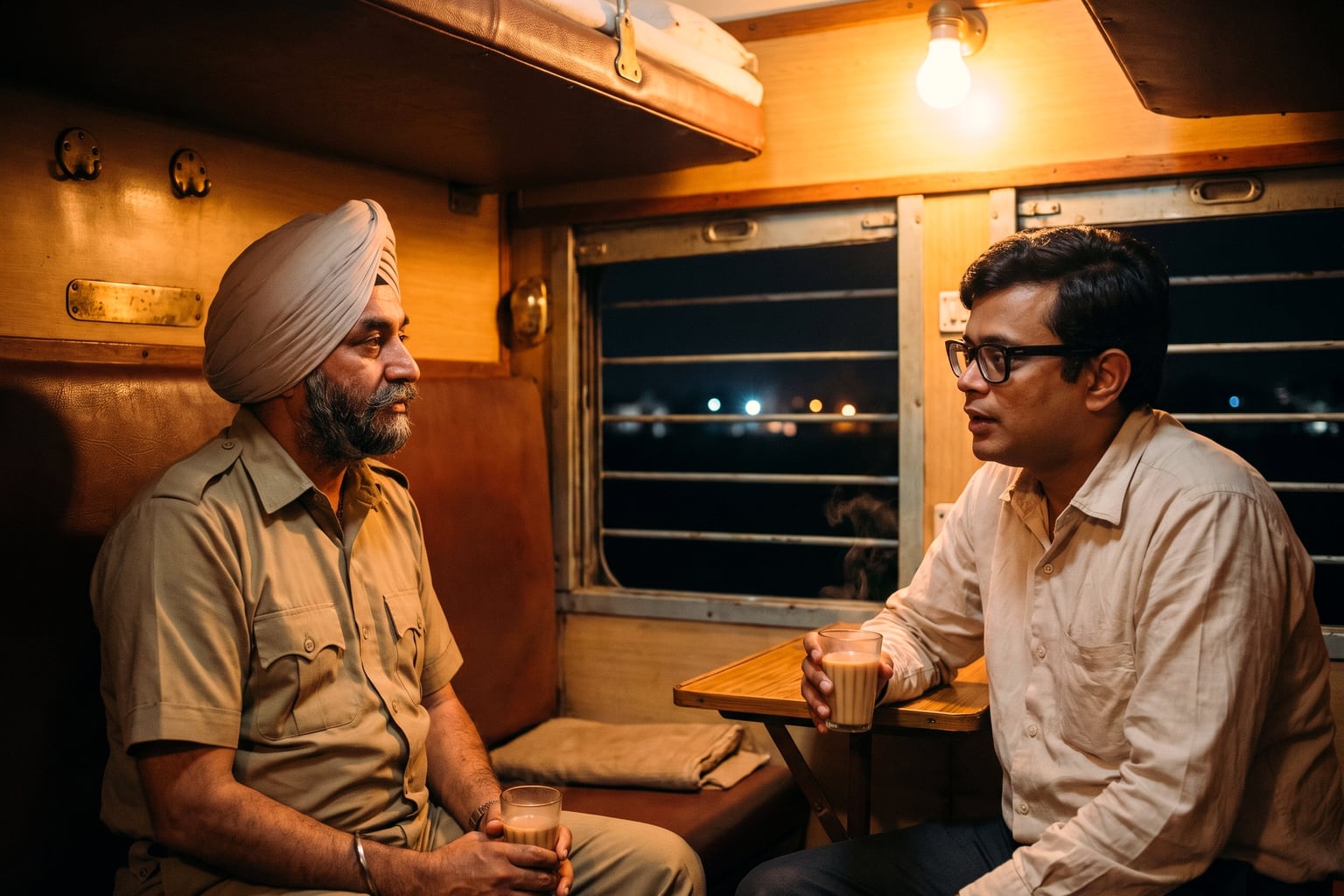
I shall always remember another interesting railway journey for an important management lesson that I learnt. In 1971, I was returning from New Delhi by the Kalka Mail. In the first-class coupé there were three officers of the armed forces travelling with me. None of them was in uniform, and I would not have known they were defence personnel had they not mentioned their names and ranks as they shook hands with me.
Seated beside me was a Sikh gentleman of the Indian Army. We were having tea together, and when I asked him whether he had ever taken part in a war, he said, “I am in the intelligence branch of the Indian Army, and I am unlikely to fight wars.” Then he turned to me.
“You work for a Chamber of Commerce, so you must have done your PhD in economics?”
“No, I did my PhD in chemistry — though you are right, most of my colleagues are economists or lawyers.”
“So you are the only man of science.”
“Well, I joined there as a techno-economic executive for chemical industries only a week ago, without any exposure to how industry works. My experience so far has been doing research for my own PhD, and guiding research as a Research Officer at an academic institution. The fields are poles apart. So I do not know whether I shall succeed.”
“In any new job, success depends on two factors. First and foremost, you must have a helpful subordinate; and second, you must please your boss. Whether you keep him happy by giving him coffee or by showing your sincerity matters very little — he must be pleased with you.”
First and foremost, you must have a helpful subordinate.
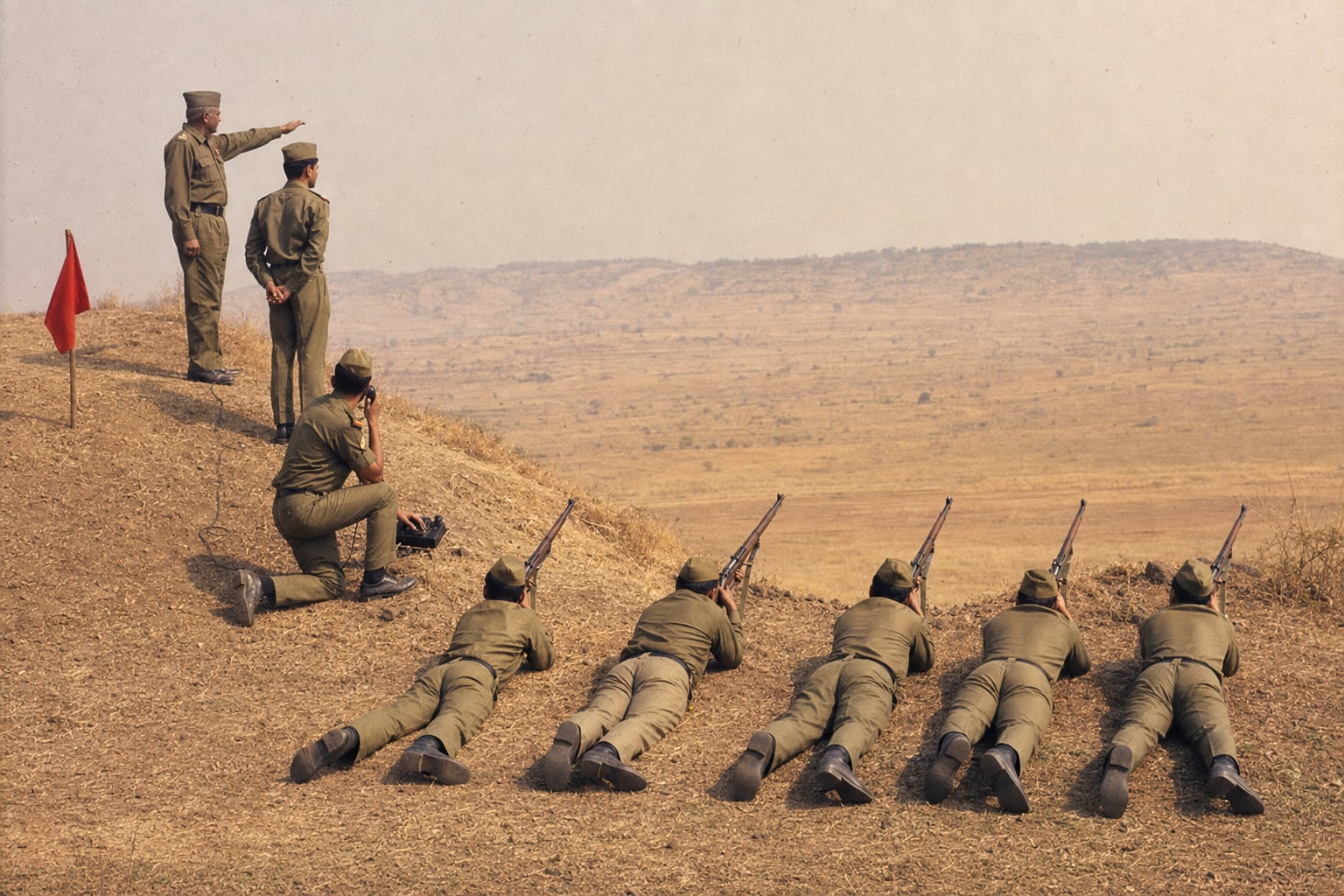
He continued, “I’ll tell you how subordinates are helpful. During my internship, I had to appear for a test in a mock war. I was taken to the top of a small hillock. Some soldiers were lying on their chests at the lowest level, their guns in position, and my subordinate stood between them and me, while the Instructor stood with me.
“The test was this: the Instructor would tell me from which direction the enemy was advancing. I had then to calculate and decide at what angle the guns were to be fired, and convey the same to my subordinate. He would announce the angle through the microphone, and the soldiers would take that as the order to fire.
“The Instructor told me the direction; I made my calculations and instructed my subordinate about the angle at which the soldiers were to fire. My subordinate, however, ignored my order. He announced a different angle for the soldiers to fire, and they fired. I realised that I had made a gross error — and that, had my subordinate carried out my order, the soldiers would have aimed their guns to fire at me.”
All four of us burst into laughter.
“Well,” the officer resumed, “I was humiliated, but the lesson was not over. The Instructor walked up to my subordinate and asked him, ‘What was the order given to you?’ My subordinate answered, ‘Sir is new. He knows the answer but made a mistake in haste.’
“You see, had my subordinate not corrected my instruction to the soldiers, I would have suffered a terrible humiliation from the soldiers — and there were a number of them.”
“I agree,” I said.
When the journey was about to end, the three officers put on their uniforms, and the junior-most gave a salute to the other two. The informal ambience of our friendly chat evaporated like camphor, and the two juniors began addressing the senior-most as ‘Sir’, speaking with due regard. I admired that sense of discipline, once they were clad in their uniforms — for I have observed that in the civil service, whether in a formal or an informal situation, they always address the senior in service as ‘Sir’.
The lesson that I carried with me all my life was to nurture my subordinates in good humour. As an executive, I always gave them a great deal of freedom in their work and encouraged them to take decisions. Occasionally I would deliberately drop out of a tour at the last moment and ask a subordinate to substitute for me; if a railway ticket was not available, I would sanction air travel. These junior officers had been making notes and preparing letters for me to sign without ever having a feel for the world those letters were bound for — so they drew a great deal of inspiration, and worked more diligently and cheerfully.
A few years later, I observed that each year there would be a mismatch in the accounting with our branch office at Bombay, and the audit would be delayed. In those days accounts were written by hand, and the desk calculator was an unknown instrument. At the branch there was no Accounts Officer, and the clerk did all the work. I decided to send our accounts clerk to Bombay, and made the proposal to my counterpart there. He liked the idea and asked his own clerk to make all the arrangements for the visiting colleague from Calcutta. This upset our Accounts Officer, who questioned me: how could a clerk be sent on tour, and how was he to pass the travel bills? I assured him that the decision had been taken in the right perspective, and that the travel bills would not be passed until the accounts were matched.
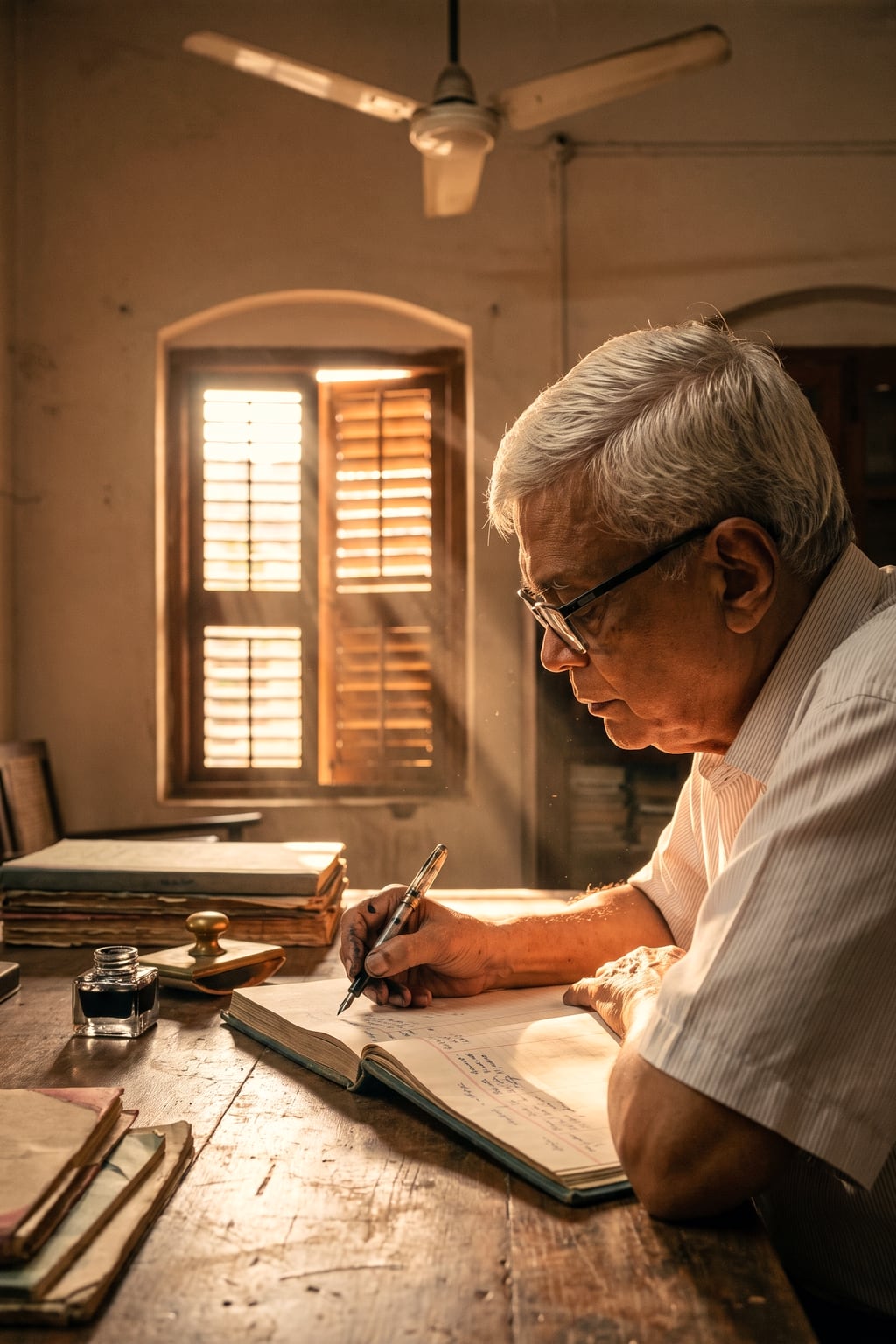
The clerk sorted out the mismatches and came back after establishing full compatibility. Thereafter we had no problem in integrating the accounts of that branch with the main accounts, year after year. Our Accounts Officer smilingly passed the travel bills.
Subordinates generally remain backstage artists for executives, but they play vital roles because of their years of experience and specialist knowledge. If properly encouraged, they can flourish and produce marvellous results for the organisation.
The discussion
Conversations about this memoir
Two readers talk this memoir over — a conversation about it, in Odia & Bengali. Not the memoir itself.