Portraits · Seeger who?Calcutta — 1 December 1963
The Banjo that Defended Justice
In December 1963, a shortcut across the Park Circus Maidan on the way to a Calcutta hospital led him into a crowd around a makeshift stage, where a tall, lanky foreigner with a long-necked banjo — a name he heard that day for the first time — had a sea of young Calcuttans singing "We Shall Overcome."
The reading couldn’t load. Download it instead.
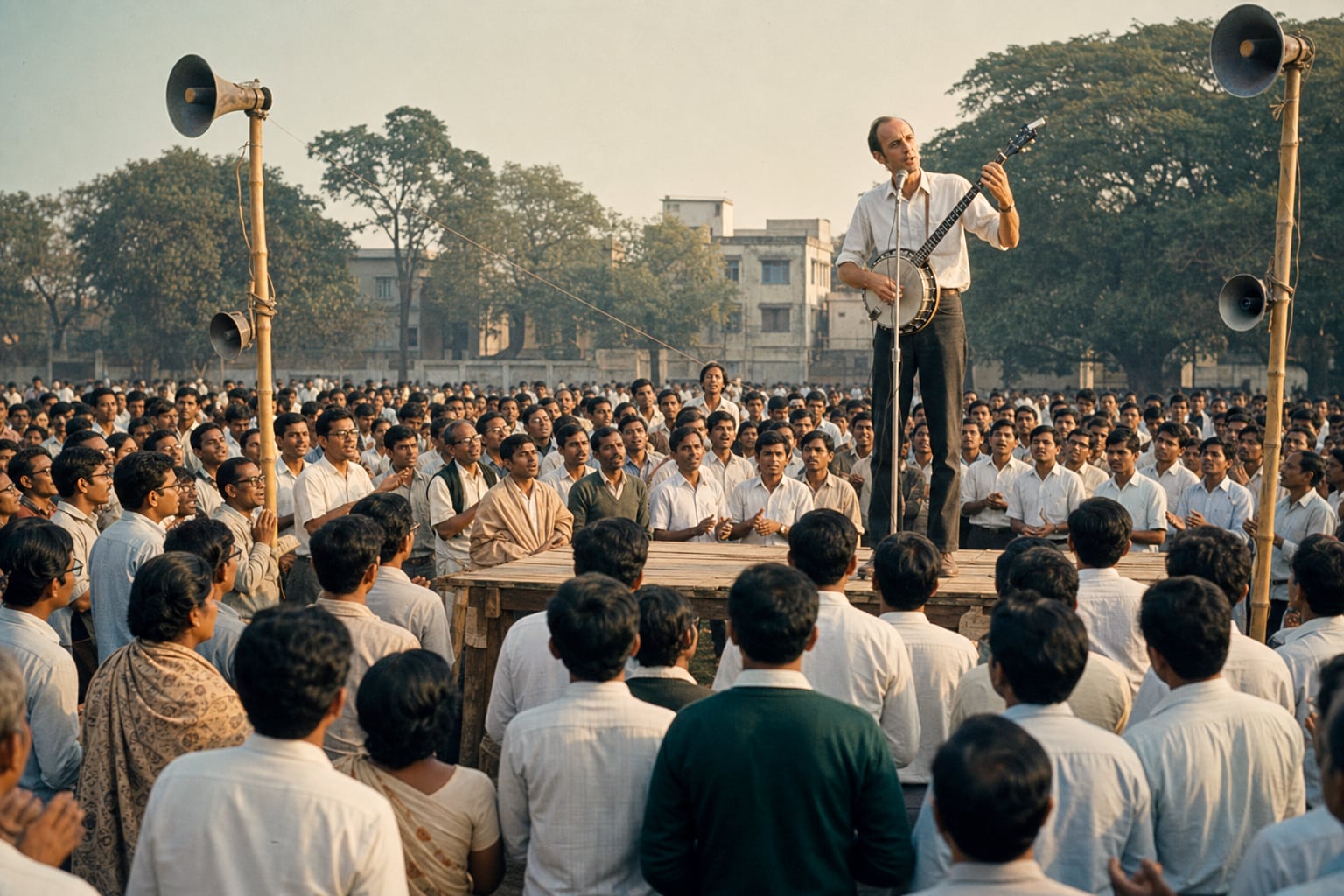
In 1963, I was in Calcutta on a weekend from my Institute, IIT Kharagpur. I was on my way to look up an ailing friend at a hospital in Park Circus. As I walked into the Park Circus Maidan to take a shortcut, I noticed an unusual crowd around a singer playing on loudspeakers. Inquisitive, I joined the crowd.
I was amazed. A foreigner was on a makeshift stage, evidently playing a banjo and singing. He was tall and lanky, with receding hair, in casual dress, singing American folk songs. Such was the magic of his singing that many in the crowd, ordinary people, some of whom looked hardly conversant in English, were keeping beat with him and trying to sing along.
There was, however, a strong student presence. I had never seen anything like it. I turned to an older person next to me and asked who the man was. Irritated by the interruption, he whispered, “Pete Seeger.” I heard the name for the first time. I was about to ask, “Seeger who?” But I dared not, and I dispersed into the crowd.
I saw a large, open-air, somewhat improvised public concert rather than a formal auditorium event.
Then the man started on a song I had heard, “Where Have All the Flowers Gone,” a protest song that had already gone around the globe. He followed with another familiar song, “If I Had a Hammer,” which was used at a protest rally as well. I stood mesmerised. He concluded with the visionary “We Shall Overcome” — a song made popular in Bengali by Hemanga Biswas as Amra korbo joy, and carried by Bhupen Hazarika into Assamese, helping it enter the patriotic student movements and group songs with resonance.
I could not visit my friend in the hospital as the visiting hours were over. Back home, when I narrated my remarkable experience to my uncle, he seemed to know a lot about Pete. I learned that Pete was a famous lyricist, composer, and singer. He had replaced the “will” with “shall” in the original motivational song of tobacco workers in America — “We Will Overcome” — and given it its new tone, rhythm and tempo. His parents were both musicologists and taught music at reputable universities in America. Pete went to Harvard on a scholarship but dropped out to play music.
In November 1996, while I was in Kolkata, Pete Seeger was again in the city. He performed at Nazrul Mancha, where he appeared with his grandson Tao Rodríguez-Seeger. I was at Kala Mandir, where he gave a more intimate joint performance with Kabir Suman, the two singing two duets. He rendered Tagore’s Purano shei diner kotha and Raghupati Raghav Raja Ram among other renditions. He was 77, but his voice was strong and melodic, quite memorable. It was a joy for me to once again listen to a splendid person who, all his life, used his songs — not to gain wealth or fame — to defend the undefended at great personal costs.
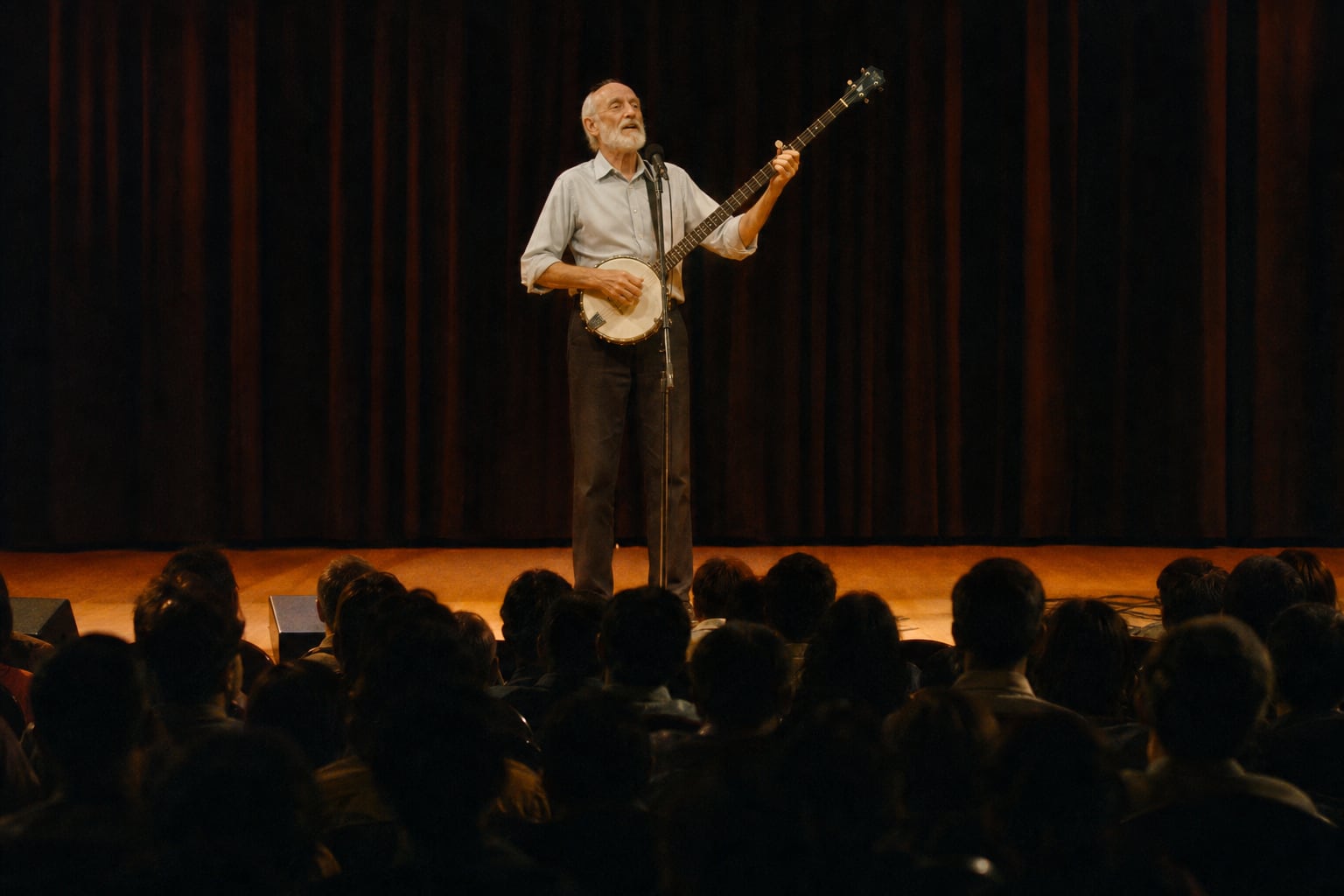
A foreigner unknown to me, with a long-necked banjo, stood before a sea of young Calcuttans, and thousands joined in “We Shall Overcome.”
I shall, however, never forget that unique experience of December 1963 at Park Circus Maidan, where a foreigner unknown to me, with a long-necked banjo, stood before a sea of young Calcuttans, and thousands joined in “We Shall Overcome.” The early 1960s were charged with student activism, global peace movements, and post-Independence idealism. For Calcutta of that era — politically alert, intellectually restless, musically sensitive — the informal, open-house rendition of Pete Seeger was more than a concert. It was an unforgettable moment of cultural solidarity.