In Transit · An entry pass on four wheelsNew Delhi — 1 December 1978
The Blue Mercedes
At the Ashoka Hotel in 1978, the Minister is held up in a Cabinet meeting, an impatient former President wants to know the extent of the delay, and the Association's Secretary rushed to the Parliament House — in a Managing Director's blue Mercedes-Benz limousine that swings open the heavy gates of the Parliament House no entry pass could.
The reading couldn’t load. Download it instead.
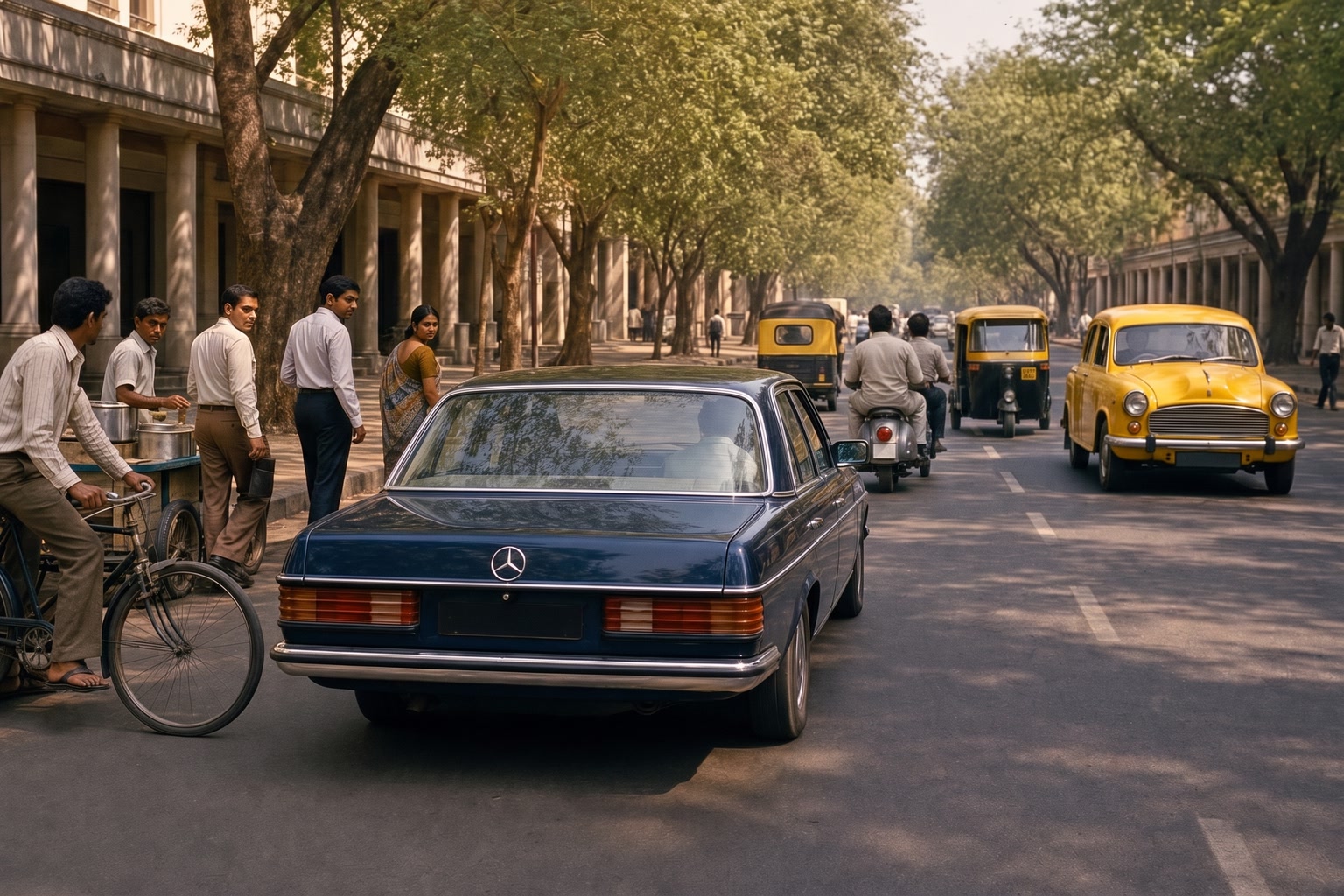
The occasion was the Annual General Meeting of the Indian Chemical Manufacturers Association at the Ashoka Hotel, New Delhi, in 1978. The meeting was scheduled for ten in the morning. As the Secretary of the Association, I was receiving the members and guests and guiding them to the venue when I was informed that a phone call awaited me at the reception desk of the hotel. A male voice told me on the phone:
“This is the Personal Secretary to the Hon’ble Minister. He is now attending an urgent meeting of the Cabinet called by the Prime Minister, Shri Morarji Desai. The Minister regrets to inform your President that his arrival at your Association’s meeting will be delayed.” The person cut off the phone instantly.
I went to the auditorium, announced the delay, and returned to the reception area to resume receiving the incoming guests. At this point one of the members of our Committee, the Managing Director of a large chemical manufacturing company, came out of the auditorium and said, “Doc, you know how meticulous and fastidious my boss, who is a former President of the Association, is. He is already impatient and wants to know when the Minister will arrive. Please go to the Parliament House and enquire at what time the Minister is expected here.”
Heaven fell on me, because it was not easy to reach the venue where the Cabinet meeting of the Ministers was being held — and further, to make an enquiry of the Minister.
“Do you have a car with you?” he asked.
At that time there were only a few hired cars, and those at a prohibitive cost; we had to depend on metered autorickshaws and the yellow taxis. So I said, “I don’t have a car; I have to take a taxi.”
He said, “Then I had better ask my chauffeur to take you to the Parliament House.” That was a great relief for me.
To my amazement, it was a blue Mercedes-Benz limousine. It was rare on the streets of India at that time since, to support the production of indigenous cars, imported cars carried prohibitive rates of tax.
The chauffeur looked quite dignified in his white kurta and white cap, like the Congressmen wore. I was wearing a new suit. He introduced himself by saying, “Sir, namaste. My name is Hari Ram.” It was easy for me to remember, as he was another Ram. As we passed through the streets, I noticed people staring at the car to find out who was riding in it. I could feel that the car and the chauffeur had added immense value to my personality.
I could feel that the car and the chauffeur had added immense value to my personality.
As I reached near the gate of the Parliament, the gatekeepers started opening the heavy gates hesitantly. I understood that they mistook me for a Member of Parliament from the business community, or a film star nominated as a member. So I told the chauffeur to drive through the gate without hesitation. After that, when I was near the first entrance to the Parliament House, one of the police officers came to talk to me. The chauffeur lowered the glass pane remotely, and I said, “We have invited the Hon’ble Minister of Petroleum, Chemicals and Fertilisers to inaugurate our Annual General Meeting. I have been informed that he is attending the Cabinet meeting. I want to know what time he is expected to arrive at our meeting.”
“Sir, you have to go to the next entrance.”
“Can I take the car there?”
“Yes, Sir.”
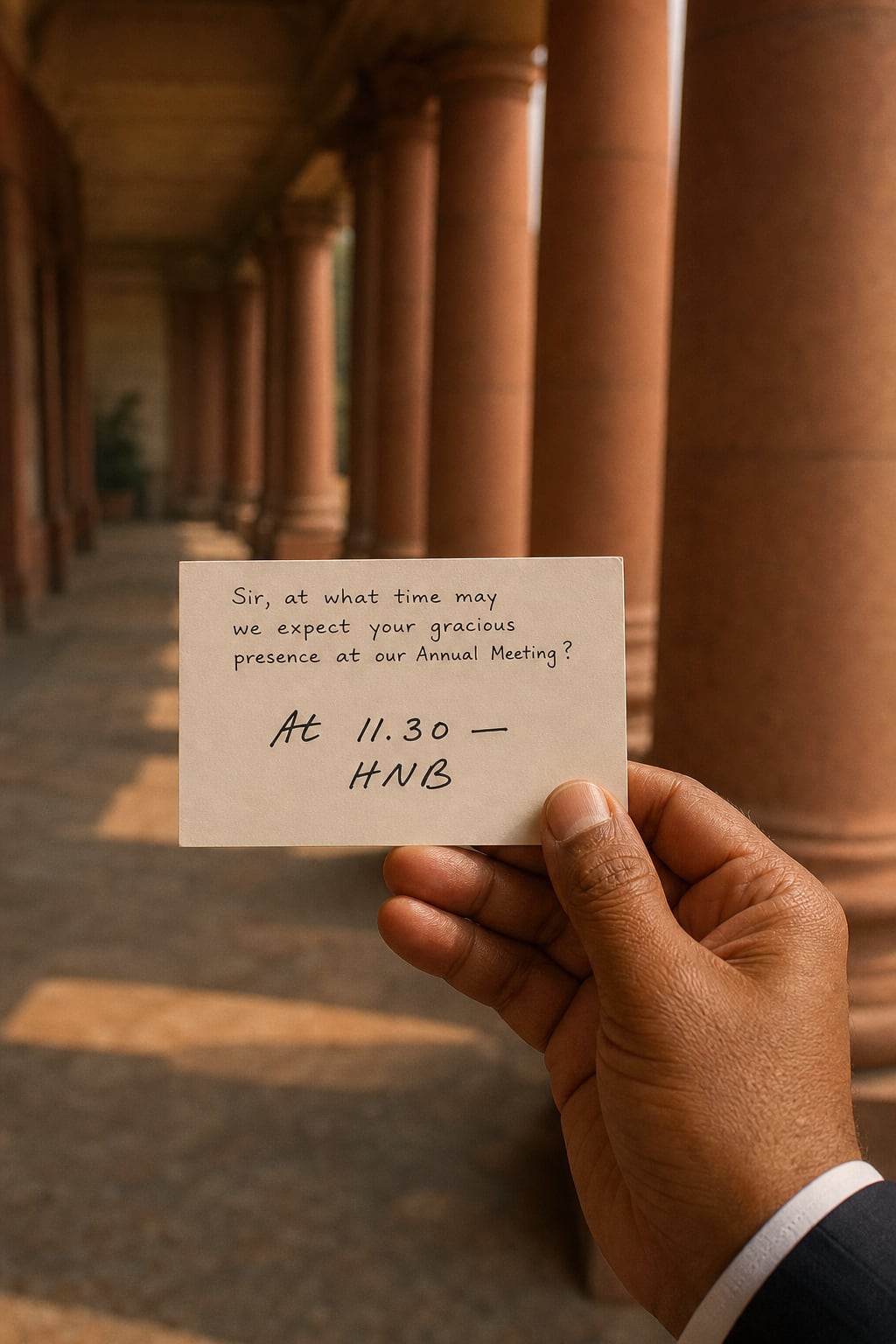
At the next entrance I had a similar reception. When I explained the purpose of my visit, they asked me to wait. After a short while a person came and asked the purpose of my visit; apparently, he was the Personal Secretary to the Minister. When I explained it, he asked me to write it down. I did not have a piece of paper. I took out my visiting card, and on its reverse I wrote:
“Sir, at what time may we expect your gracious presence at our Annual Meeting?”
The person went in and returned within minutes to hand back my visiting card. After my note the Minister had written, “At 11.30”, with the initials “HNB” — the Cabinet Minister’s name being Hemavati Nandan Bahuguna.
I returned to the auditorium within half an hour and made the announcement. We requested the guests to have tea, and the members stayed back to complete the formalities of the business session of the meeting. The Minister arrived a few minutes earlier than we expected.
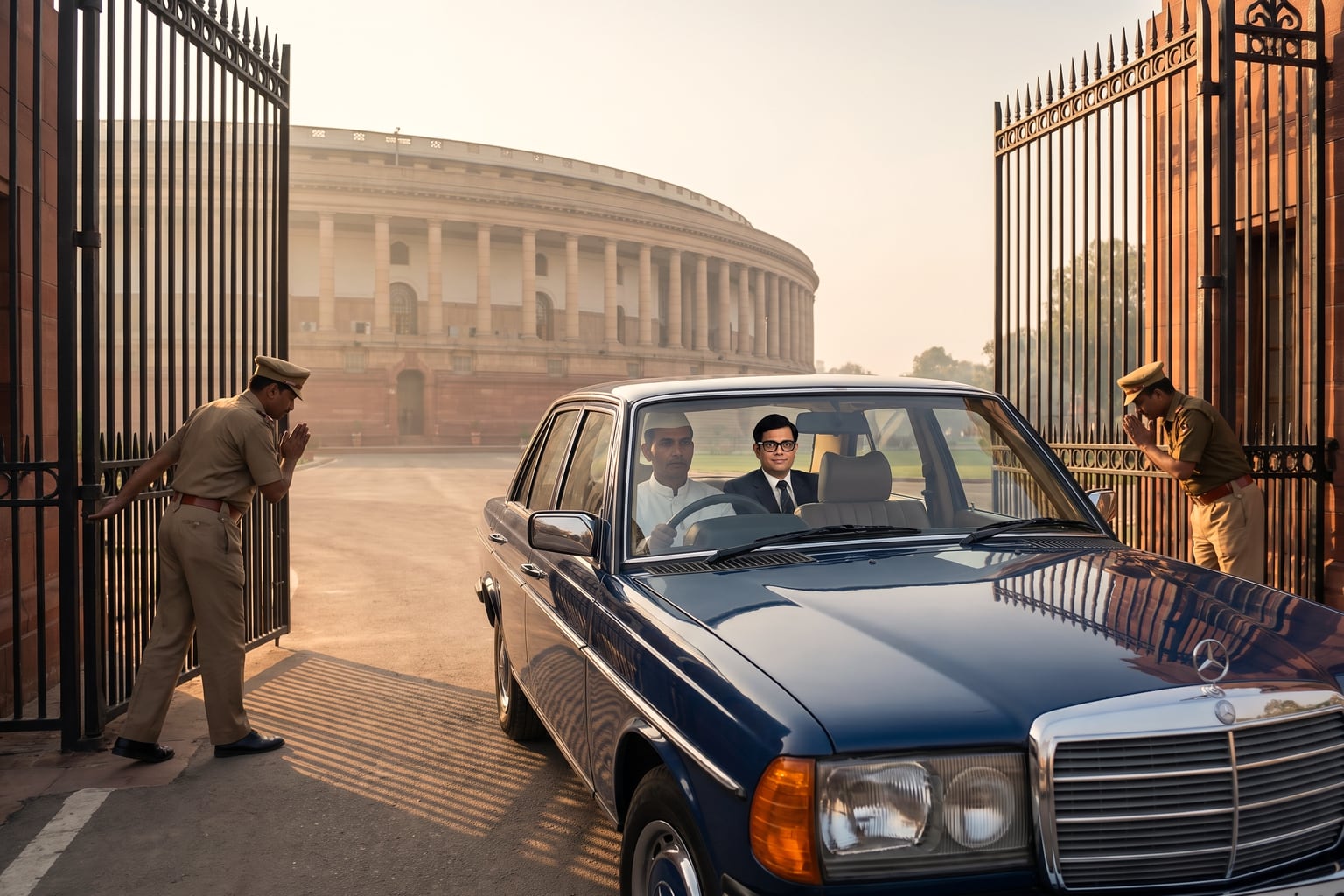
In those days, terrorism had not yet cast its long shadow over everyday life in India. Perhaps I owed my easy entry to the Parliament House partly to the limousine in which I arrived. Had I come in an ordinary taxi, I do not know how long I might have waited to complete the formalities for an entry pass — or whether the security personnel would have permitted me to approach the Minister at all.
In the 1960s, terrorism was still, for most Indians, little more than a word encountered in the dictionary. Security personnel relied largely upon observation, instinct and human judgement. I remember seeing only two armed policemen outside the gate of the Prime Minister’s residence in New Delhi. Inside, however, a formidable contingent of officers and security staff carefully checked every visitor.
How profoundly the world has changed. Today, even if I were to arrive at a hotel in that dream car — a yellow Rolls-Royce — the car itself would be scanned, I would have to pass through a security detector, and my backpack through another. We may be better protected now, but somewhere along the way we have lost the quiet trust and innocence of the earlier age.