Portraits · The war overheadKharagpur — 7 September 1965
The dogfight over Kharagpur
On the morning of 7 September 1965, a research fellow walking back from the library at IIT Kharagpur looked up to see one jet in furious pursuit of another — and the following Sunday sat down to lunch at Kalaikunda with the Hunter pilot who had taken on four Pakistani Sabres, split from his wingman against every rule of air combat, and kept the bombs off the campus.
The reading couldn’t load. Download it instead.
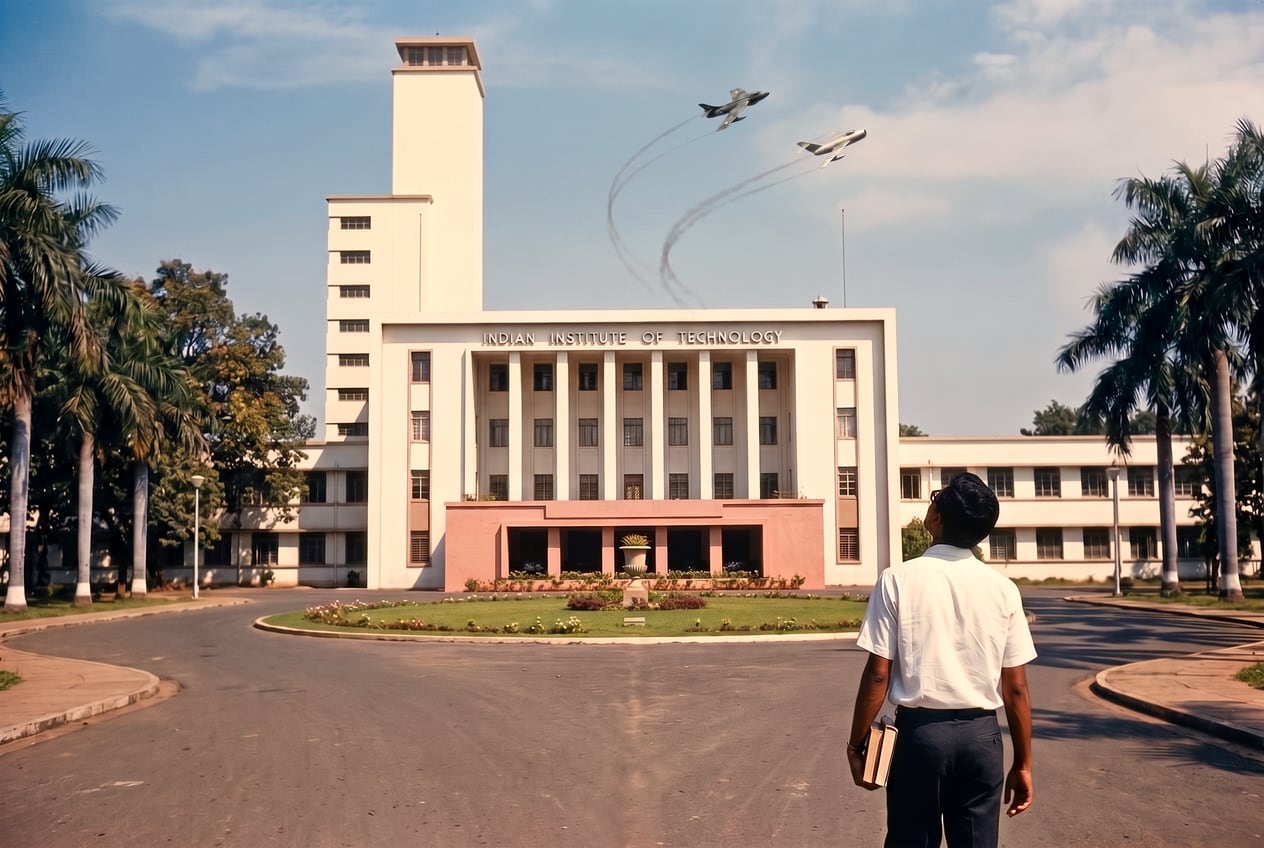
When I joined the Department of Chemistry at the Indian Institute of Technology, Kharagpur, in 1963 as a Research Fellow, my days began with the occasional thunderous roar of fighter aircraft flying overhead. I was told that these were the pilots’ practice exercises from the nearby Kalaikunda Air Force Station. They would carve trails of white smoke under the blue sky. Often they would fly so low that we could make out the pilot’s silhouette against the fuselage.
I got used to the roar and rarely looked up. In 1965, we realised that the exercises had become more rigorous than usual, as war clouds gathered between India and Pakistan on India’s north-western frontier.
At that time Pakistan had a bifurcated structure — the erstwhile West Pakistan, and, to the east of West Bengal, the East Pakistan that would ultimately culminate in the emergence of Bangladesh in 1971. The hostilities between India and Pakistan were, however, spread across the western frontiers, from Kashmir to Punjab and Rajasthan. India’s eastern boundaries were relatively much quieter.
Roars of the fighter planes, however, became more frequent in the sky above our Institute. Then, at around 10:30 a.m. on 7 September 1965, while I was returning from the library, I heard a new intensity in the engines’ roar. I looked up just in time to see one jet in furious pursuit of another. Within seconds, they were gone — and then came the concussion of a crash. A lone aircraft limped away, and black smoke spiralled into the sky.
Those who witnessed the dogfight presumed that a Pakistani fighter jet had been shot down, and erupted in cheers. By lunchtime, the news emerged: an American-made Sabre jet belonging to the Pakistan Air Force had plummeted into a peasant’s hut, killing two villagers.
It was some hours before word reached us of the spot where the aircraft had come down. I pedalled my bicycle out there and reached the wreck about four hours later. The twisted wreckage was still smouldering. The pilot’s body lay battered among the debris — a grim testament to the sudden proximity of war. A whispered rumour in the village claimed he was once a tailor in Kharagpur town — an ironic footnote that spread faster than the smoke. Later I learned that the name of the Pakistani pilot was Flying Officer Afzal Khan.
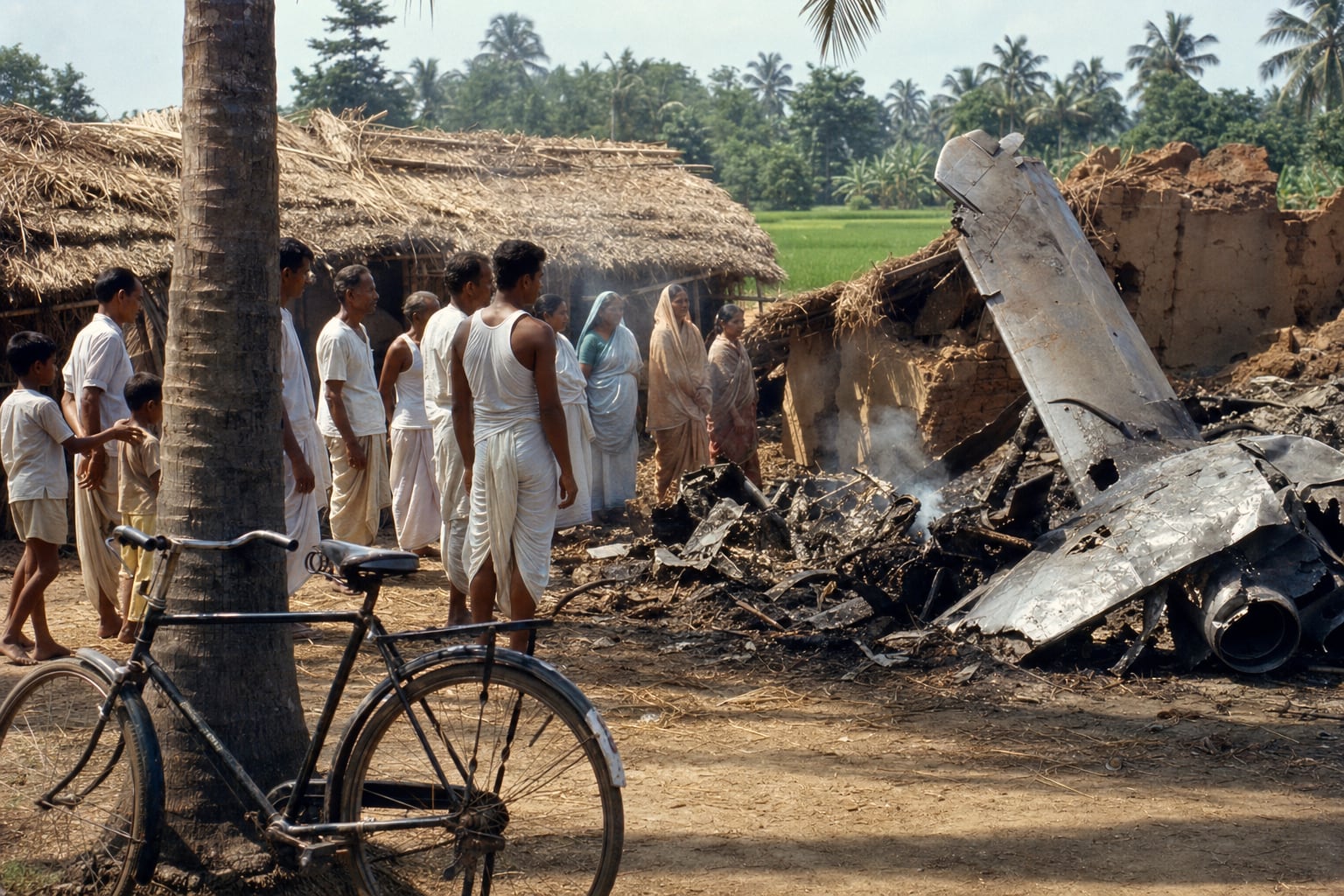
At that time, we depended on All India Radio for news updates at a few fixed times throughout the day, or read the newspapers the following morning. The radio announced that Flight Lieutenant Cooke and his wingman, Flying Officer Subodh Mamgain, had intercepted four U.S.-built Sabre jets of the Pakistan Air Force bent on striking Kalaikunda.
It was reported that in the ensuing engagement, one Sabre was downed at a village near Kharagpur, and another, though badly damaged, escaped only to crash near the East Pakistan border. The remaining two intruders fled the scene. The skirmish ended as a clear triumph for the Indian Air Force, safeguarding Kalaikunda and our campus from potential bombardment.
Digital photography had not yet been invented. Mobile phones with cameras, television news crews capable of live coverage, and the instant sharing of images through the internet belonged to a future generation. No one, anywhere, could have anticipated an air battle breaking out overhead and kept a camera ready to record it.
Consequently, no photographs of that dramatic dogfight exist. It survives only in my memories, and in the handful of eyewitnesses who happened to look up that morning and watched the fleeting silhouettes of fighter aircraft locked in combat. It was a spectacle reminiscent of the black-and-white war films of that era.
Meeting the men who defended Kalaikunda
The unexpected dogfight in the skies of IIT Kharagpur lasted only a few minutes. Having visited the village where a Pakistan Air Force Sabre jet was burning slowly, I realised what could have happened if it had been an Indian Air Force jet. The Pakistani pilot could have bombed our Institute and Kalaikunda.
My classmate Ravi Chopra was posted at Kalaikunda as a Commissioned Officer in the Engineering Division. We had taken our postgraduate course together and shared a hostel for a year — he in the Electronics Department, I in Chemistry. Perhaps that is why I felt an irresistible urge to meet the men behind those distant silhouettes. I wanted to meet the pilots whose skill and courage had shielded Kalaikunda and, quite possibly, our own campus, from destruction.
I visited Ravi on the following Sunday, and was fortunate to meet the tall, lanky Flight Lieutenant Alfred Cooke at lunch. Mamgain was in a hospital.
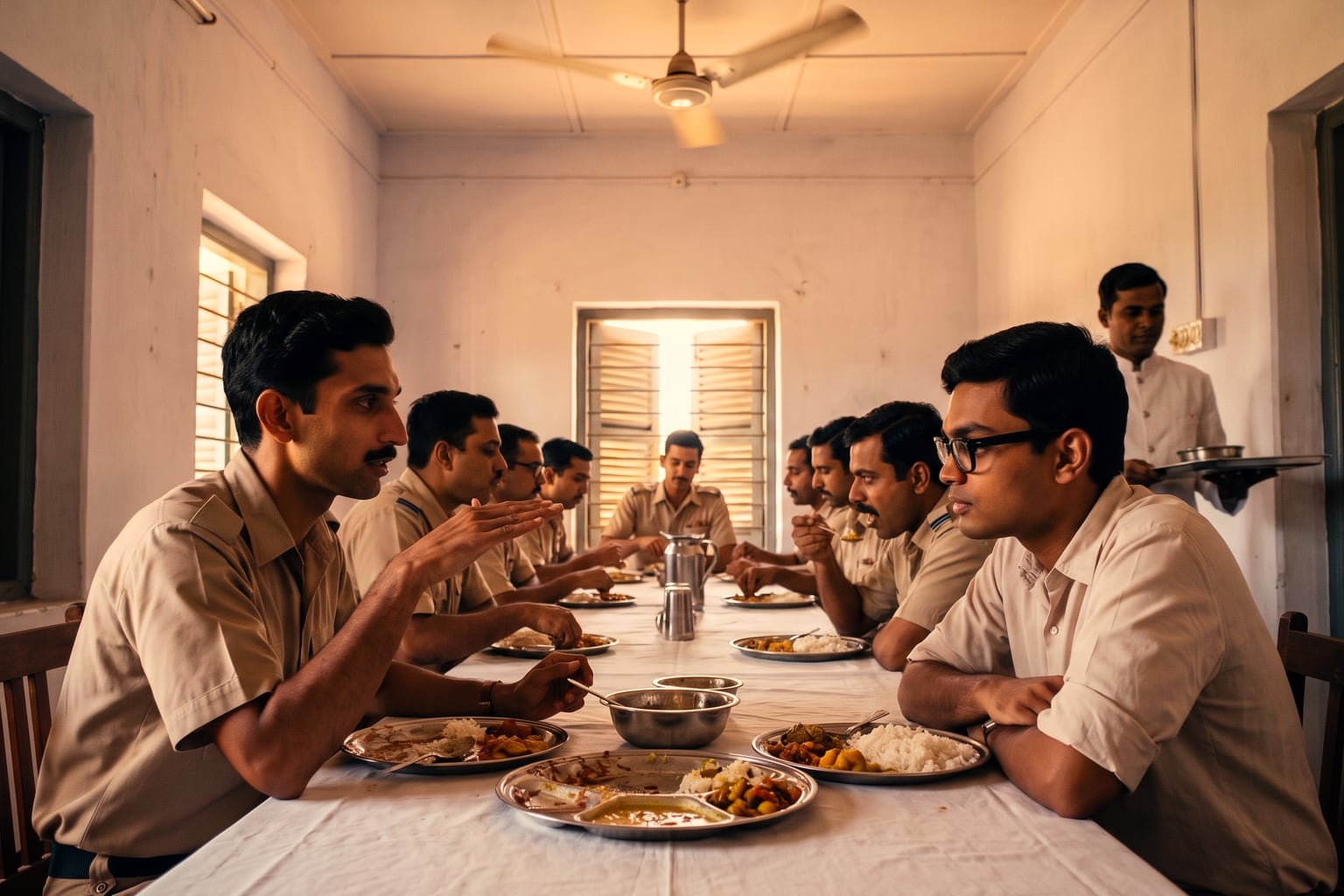
Cooke said:
“I had just taken off from Dum Dum, near Calcutta, and was flying towards Kalaikunda. I was informed about the Pakistan Air Force’s advance towards Kalaikunda, and was asked to intercept those aircraft with Flying Officer Mamgain as the wingman, since we both flew from Dum Dum.
“When I was in the vicinity of Kharagpur, we were shocked to see three PAF Sabres employing a classic front-gun racecourse pattern of attack on one side of our runway, while the fourth kept top cover on the other side. It was unclear if a few more aircraft were following that fourth one. So the equation was two against four, plus. For the two of us, it was a do-or-die situation.
“My plan was clear. I told my colleague, Mamgain: we have to get them before they proceed further. I will deal with the three on this side, and you take on the one on the opposite side. If you are lucky, it will be a loner, and even if there are one or two more, do your best.”
He went on:
“Usually, in air battles, the wingman stays glued to the leader’s tail. But I thought it would be best if I tackled the three visible Sabre jets and asked my wingman to deal with the fourth aircraft. By chance, there may not be any more with it. So I instantly decided to split up and take on the three Sabres. Later, we realised this was the most remarkable decision, and the Pakistani pilots were surprised.
“I targeted the Sabre which was flying very low as it prepared to release the ammunition. The pilot had descended so low that I could see the trees in my gun camera when I aimed to fire at him. I adopted the ‘scissors strategy’, one of the air combat techniques used by military fighter pilots to defend and distract. I made a series of short turns towards the Sabre, slowing down with each turn to force it to overshoot. The pilot of the Sabre and I were both getting behind each other. I was perhaps more desperate than he was, while he was more confident. When I fired, I could see the fair face of the pilot and his name printed on the back of his white helmet. My gunshots hit the Sabre. It exploded and crashed. I was so close that I could not avoid flying through the disintegrating parts of the Sabre.
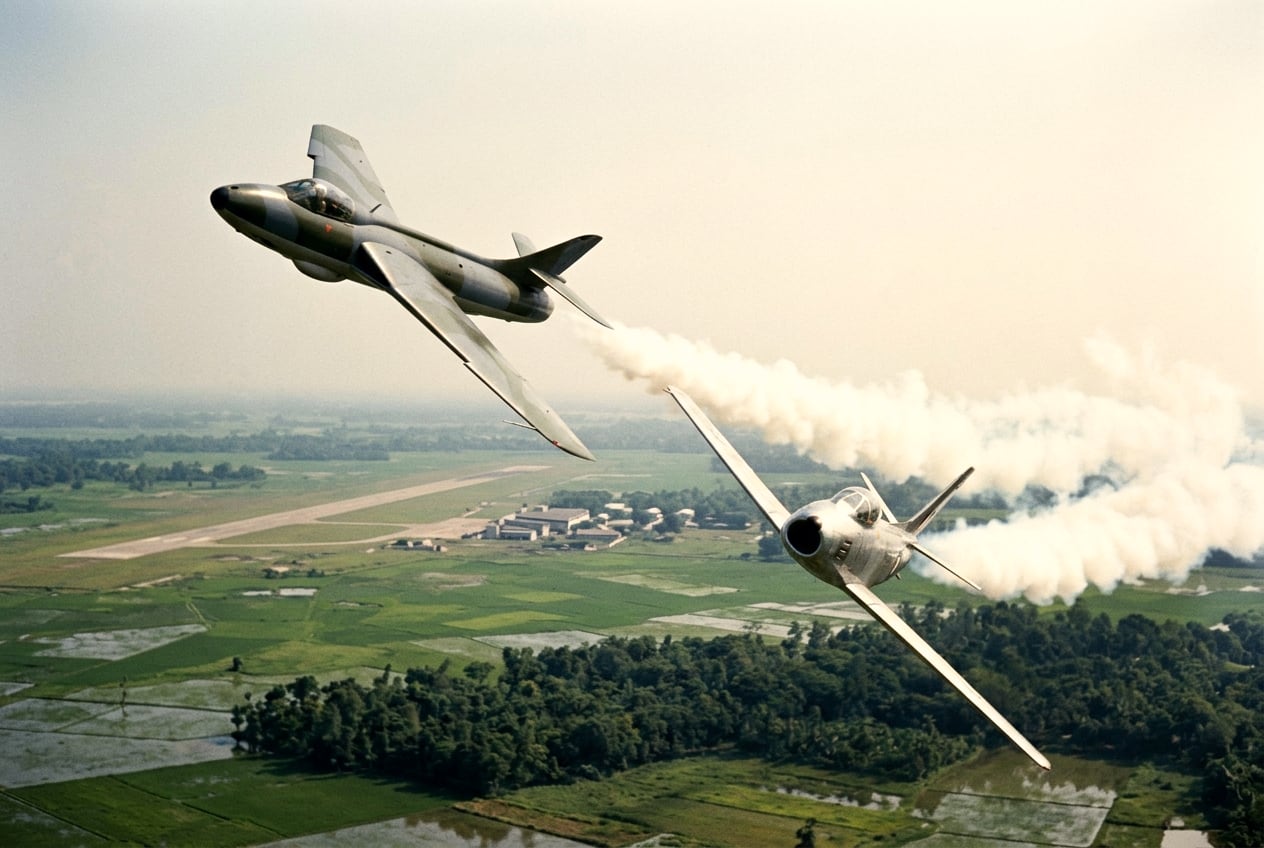
“Thereafter, when I looked around, I saw another Sabre behind me. Again, in desperation, I started criss-cross scissors and got into an advantageous position. Realising his precarious situation, he began firing while trying to get away from me. While firing at him, I felt he was being warned by another Sabre, which could have been behind me. I kept firing and closing in rapidly on him, and could see pieces of his aircraft disintegrating. Speed — usually the greatest asset of the Hunter’s superior engine — was suddenly becoming a liability, since I was so close that if I did not break away, I would collide with the Sabre.
“At this point, the third Pakistani Sabre got scared and decided to escape. This was a blessing for me, since I had no ammunition left.
“My task was completed, and I would have liked to call it a day. Until then, I was so engrossed in fighting out three Sabres that I had lost touch with my wingman. I saw he was in mortal danger now, since the Sabre behind him was in an advantageous position. When I started chasing, that pilot started doing loops and aerobatics to try and shake me off. I had no problem staying behind him at this stage, but I had no ammunition to fire. The guy there escaped.”
“Yes,” I said, “I am one of the fortunate eyewitnesses to the dogfight — and today I have learned from you that what you did is a scissors combat.”
“You’re lucky,” Cooke told me, “because I was lucky. Had I fallen, those Sabres might have levelled your Institute — and Kalaikunda. In a dogfight, bombs rain down, and civilians pay the price. Few who watch such aerial duels live to tell the tale.”
You’re lucky, because I was lucky.
There was an informal dinner at the air force station at Kalaikunda, and I was Cooke’s guest at it. There were no speeches; the award had not yet been announced. It is a memory as vivid as the roar of those jets overhead.
Later in 1965, while I was still at IIT Kharagpur, both Flight Lieutenant Alfred T. Cooke and Flying Officer Mamgain were awarded the Vir Chakra by the Government of India for their gallantry during the 1965 war. Yet I often wondered why Cooke, whose exceptional leadership and courage had thwarted the Pakistan Air Force’s attack on Kalaikunda against overwhelming odds, was not considered for the nation’s highest wartime gallantry award, the Param Vir Chakra.
My friend Ravi, through whom I had earlier met many Air Force officers at Kalaikunda, was no longer posted there. Consequently, I never had the opportunity to meet Cooke personally to congratulate him on his achievement. As the years passed, I gradually lost touch with him.
Many years later, I read in newspaper reports that Flight Lieutenant Alfred T. Cooke had resigned from the Indian Air Force in 1967 and had settled in Australia. I do not know the reasons behind his decision. Yet I could not help wondering whether the absence of the nation’s highest recognition for an act of such extraordinary courage had left him deeply disappointed. Perhaps he chose to begin a new life far away rather than live under the shadow of that lingering sense of injustice.
I wrote, earlier in this account, that no photographs of that dogfight exist, and that it survived only in the memories of the few of us who happened to look up. I was wrong, and I am glad to be wrong.
Cooke’s gun camera was running — the same camera in which, as he told me over that lunch, he could see the trees as he closed on the Sabre. He kept the film. In early 2000 the historian Samir Chopra traced him to Australia, recorded his account of that morning, and was given the photographs. They were published in The India–Pakistan Air War of 1965 by P. V. S. Jagan Mohan and Samir Chopra (Manohar, New Delhi, 2005), and are reproduced with fuller captions in the same authors’ account, One Vs Four: The Complete Story of Alfred Cooke’s Epic Air Combat. Among them is a photograph of the Sabre’s wreckage near Kharagpur.
I am grateful to those two authors. It took patience, and a kind of passion, to find an old pilot on the other side of the world, to draw the account out of him, to gather the photographs and the records, and to set them down as a document that carries the untold story of Cooke’s bravery and presence of mind to posterity. Without them, that morning would have stayed where I had left it — in the memory of a few men who happened to look up.
So the thing I believed no camera had caught was being recorded all along — from the only place it could have been, the cockpit of the Hunter, by the man who was doing it.
Unlike Major Dhyan Chand, who endured years of neglect in his own country after bringing it unparalleled sporting glory, Cooke may have sought to leave behind the memories of what he felt had gone unrecognised. Whether or not that was the reason, his remarkable feat over Kalaikunda — nay, over IIT Kharagpur — deserves to be remembered as one of the finest examples of courage and leadership in the history of the Indian Air Force.