The Steeping

The plates

An illustrated record

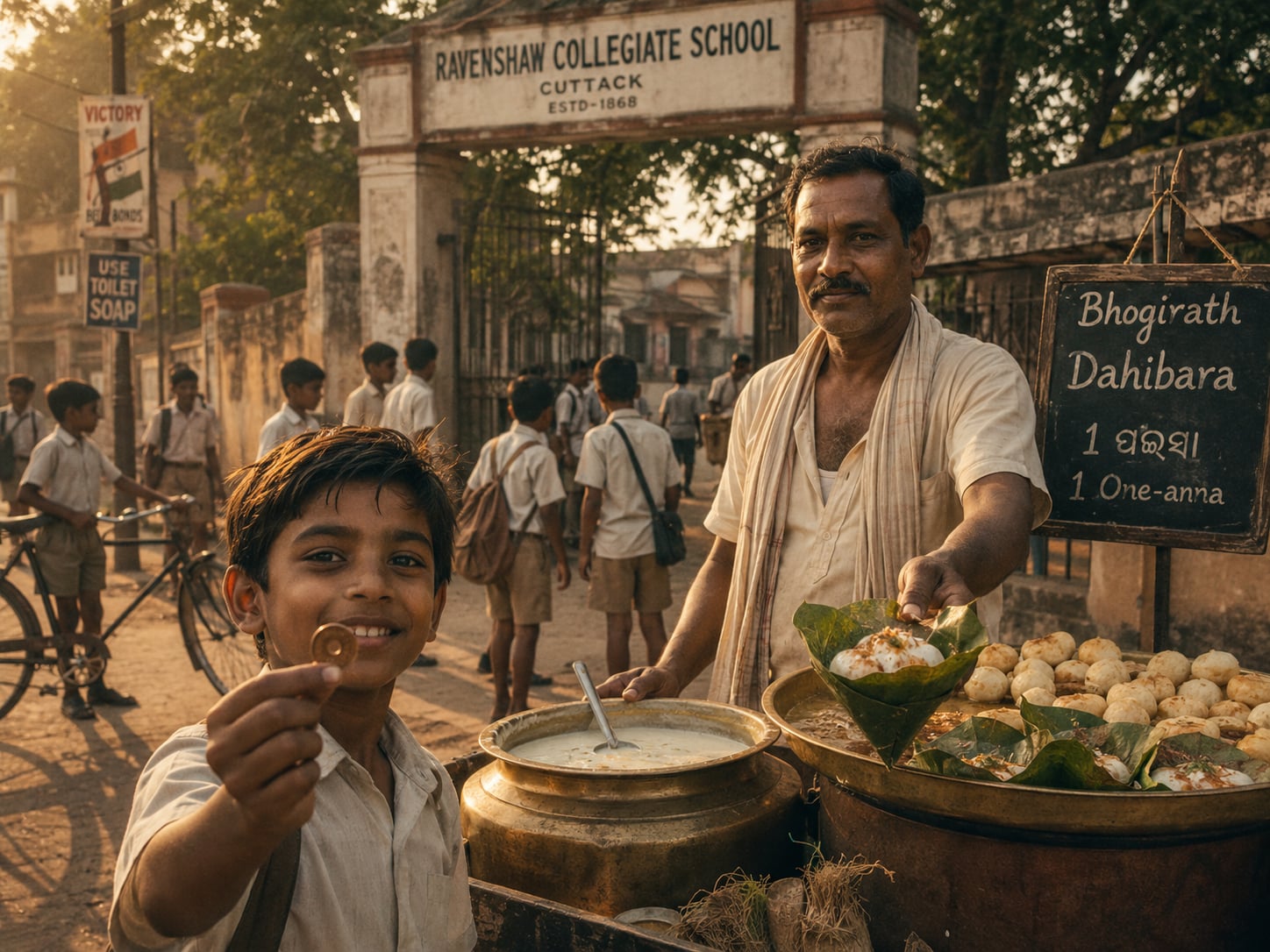
A moustached dahibara vendor in a pale shirt and a checked shoulder-cloth leans out to serve dahibara folded into a green sal-leaf cone, beside a brass pot of buttermilk and a brass tray heaped with round pale dahibara; in the foreground a smiling schoolboy holds up a small coin; other schoolboys and a 1950s street stand behind, before the red-and-white arch of an old school gate in warm golden light.
Plate Ia schoolboy holds up his coin at bhogi's school-gate dahibara stall, cuttack.
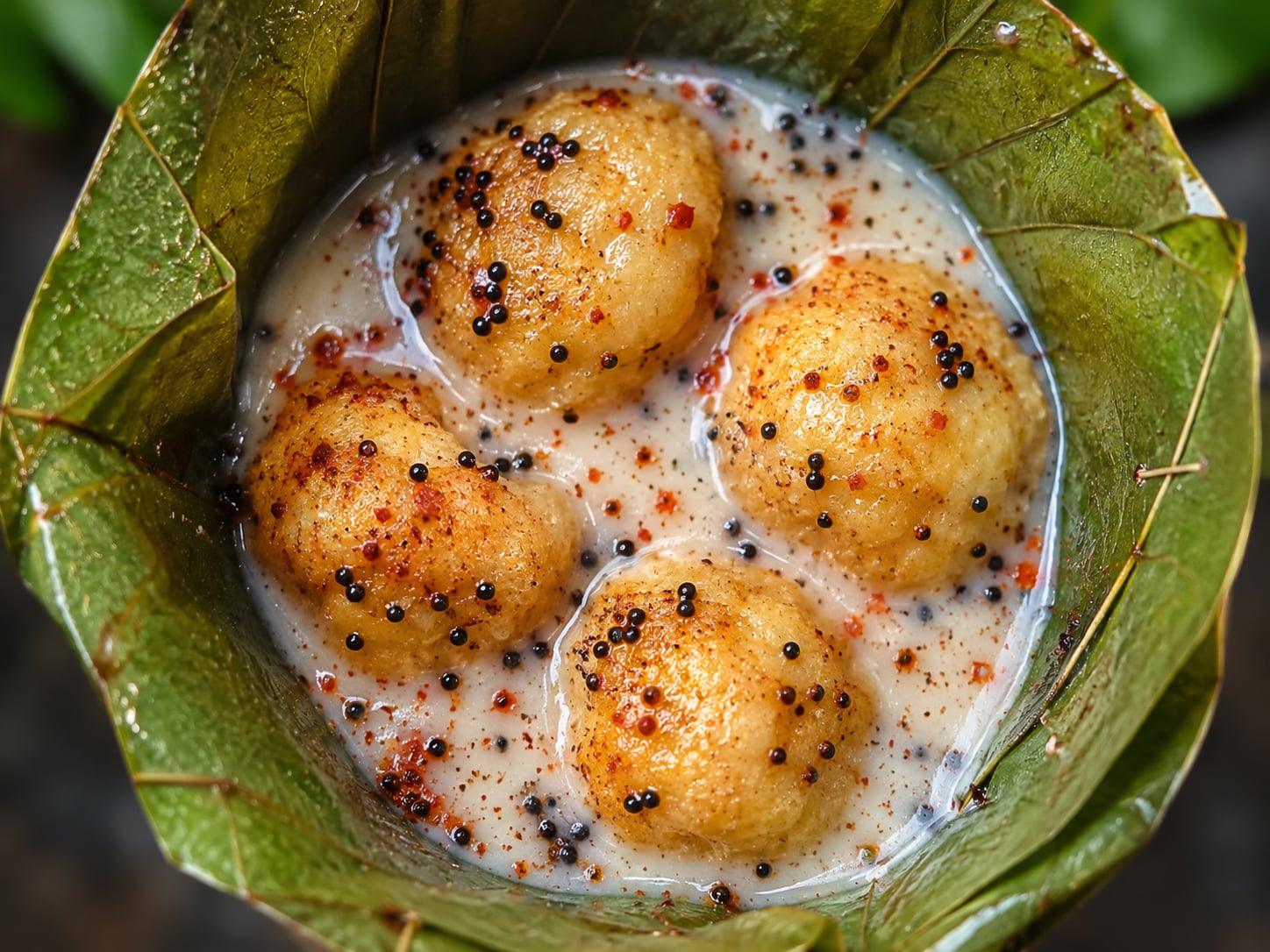
Overhead macro of four golden dahibara dumplings in a folded green sal-leaf bowl, pooled in white buttermilk and scattered with black mustard seeds and red-chilli flecks.
Plate IIfour pieces of dahibara, one anna.
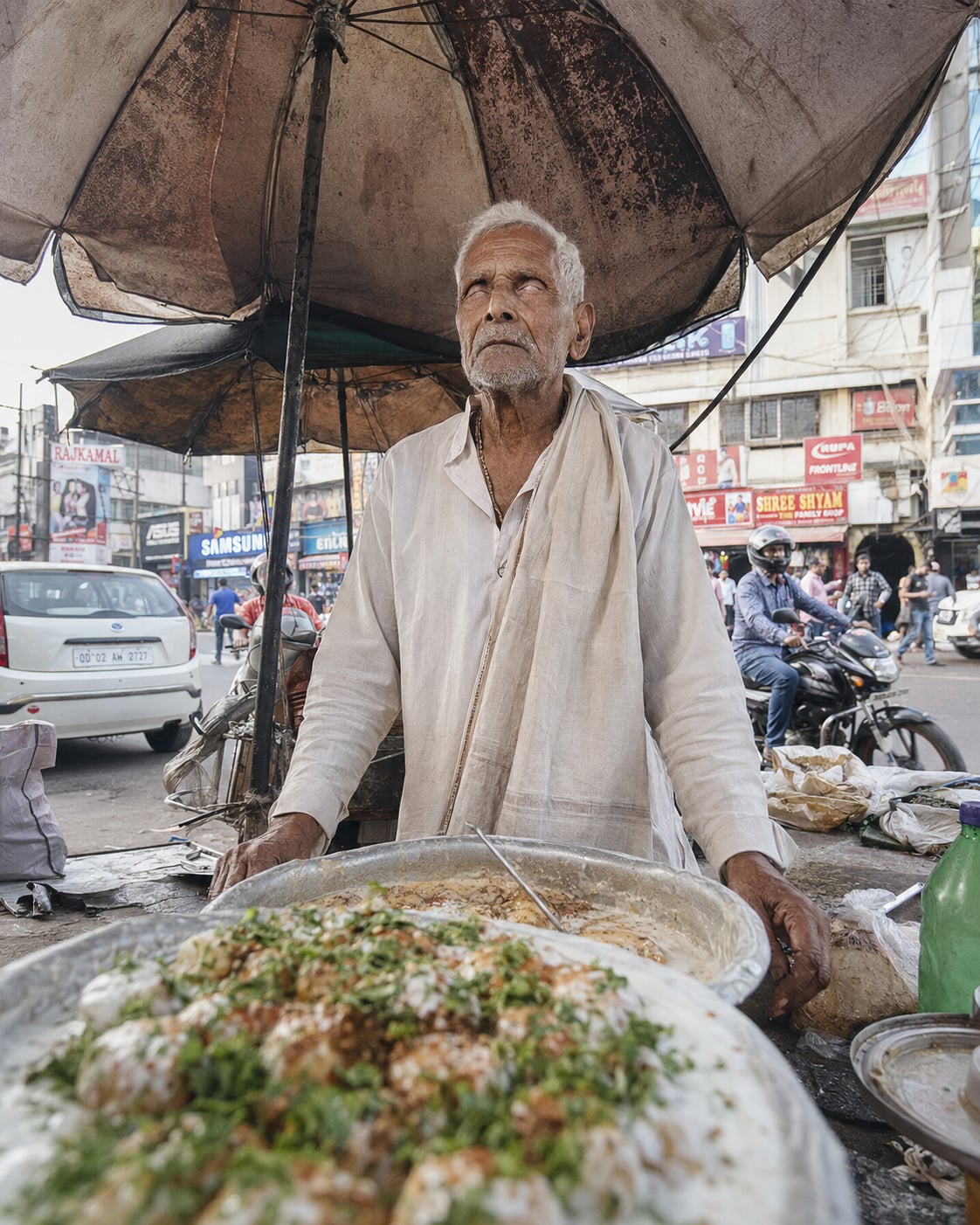
A white-haired elderly vendor with clouded, unfocused eyes stands tall and erect in a cream kurta beneath a large weathered umbrella, behind big aluminium pans of dahibara dumplings garnished with coriander and red chilli; behind him a busy modern street with a parked car, a helmeted motorcyclist, pedestrians and shop hoardings.
Plate IIIbhogi, blind now, stands erect over his aluminium pans as a modern cuttack rushes past.
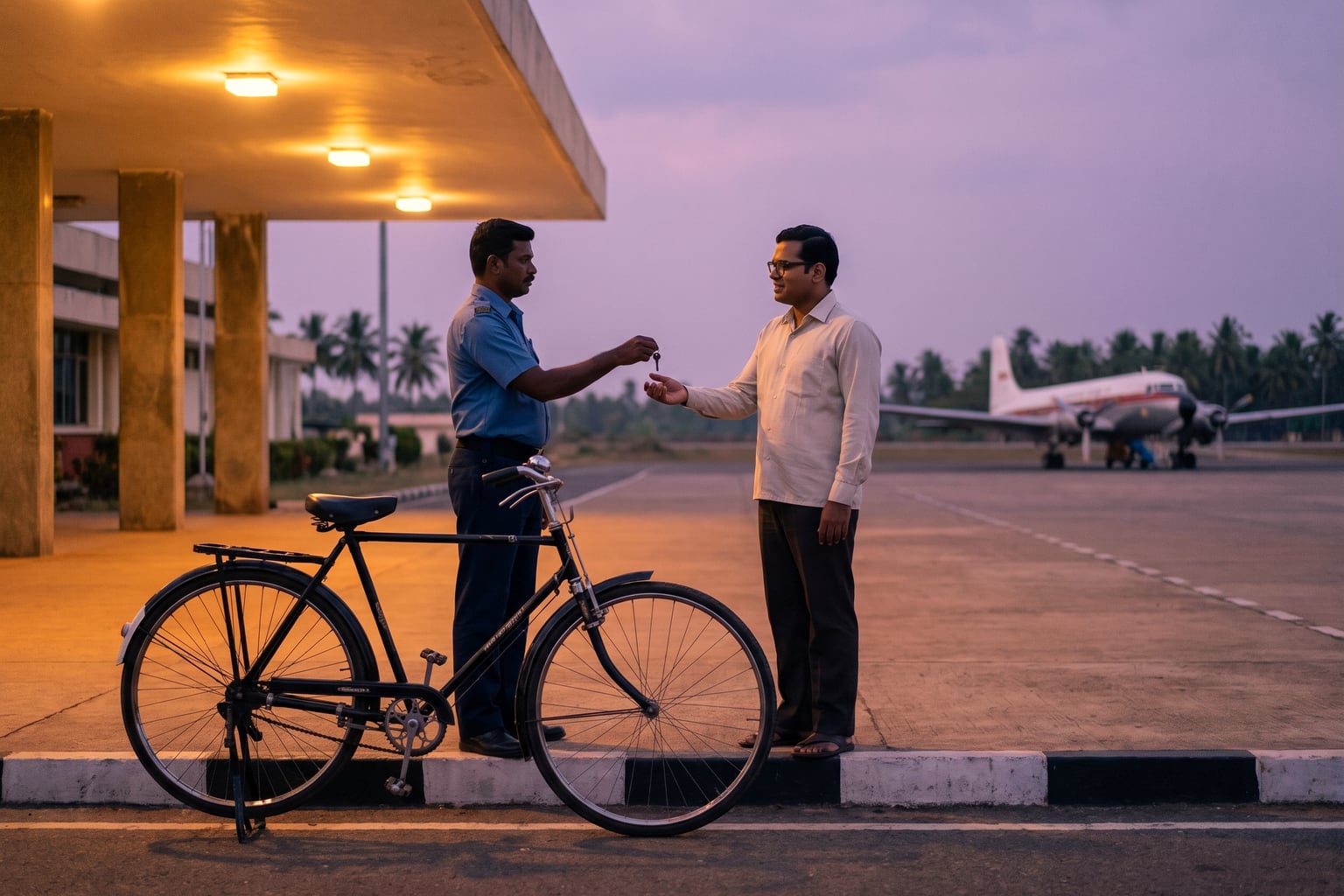
A security guard in a blue uniform holds out a small key to a young bespectacled traveller in a pale shirt, empty-handed, who reaches to accept it; the guard's black roadster bicycle stands on its stand at the kerb beside them outside a small airport terminal at dusk, palm trees and lit canopy behind, and a 1960s propeller airliner on the apron under a violet sky.
Plate Idusk at the terminal: the key changes hands; the bicycle waits.
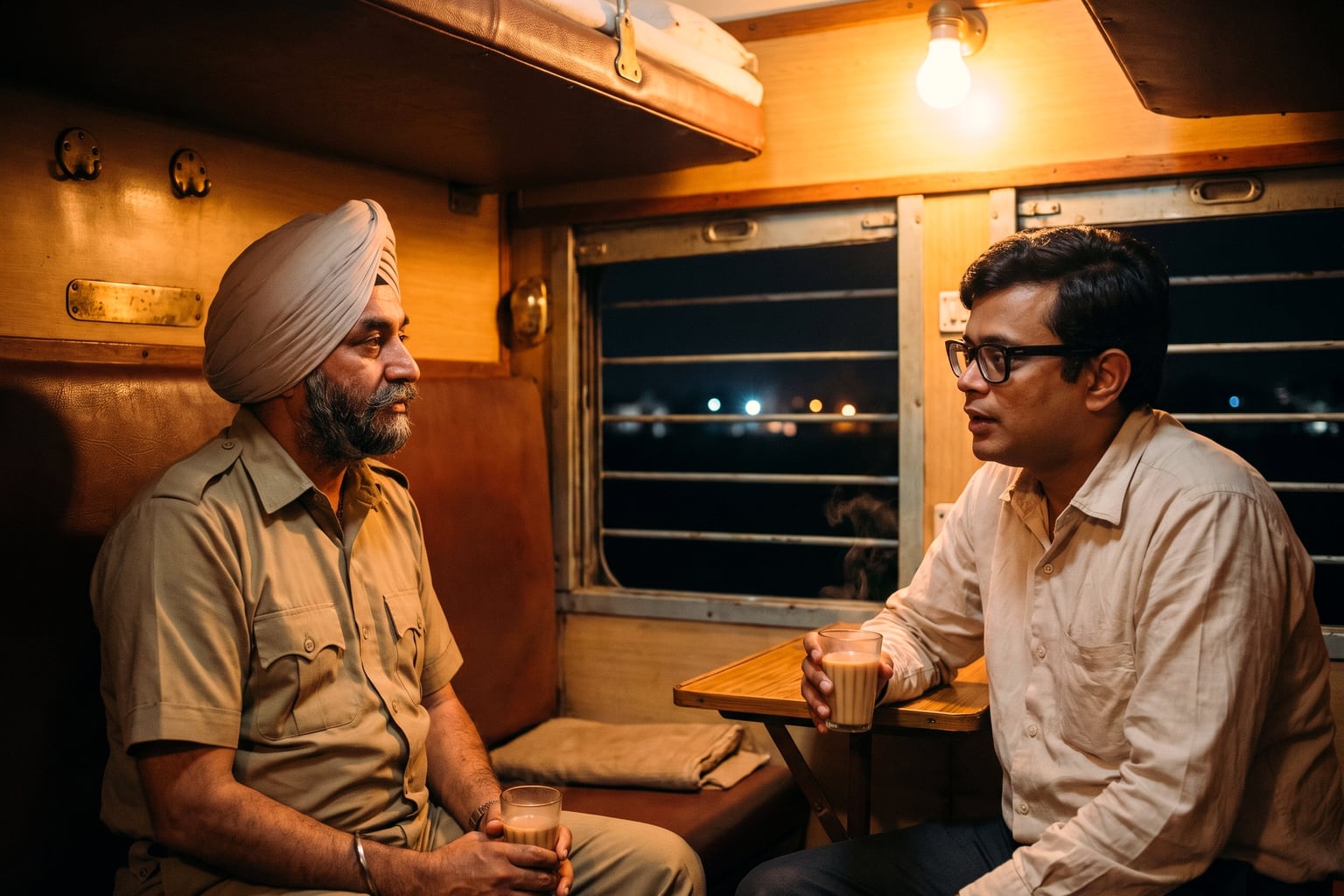
Inside a wood-panelled 1971 railway coupé lit by a single warm amber bulb, a turbaned grey-bearded man in a plain bush-shirt and a younger clean-shaven bespectacled man in a rumpled shirt sit facing each other across the compartment with glasses of milky tea, the empty upper berth folded flat against the wall above and the barred night window between them showing scattered distant town lights in the dark.
Plate Itwo glass tumblers of railway tea, and the town-lights scattered far across the dark.
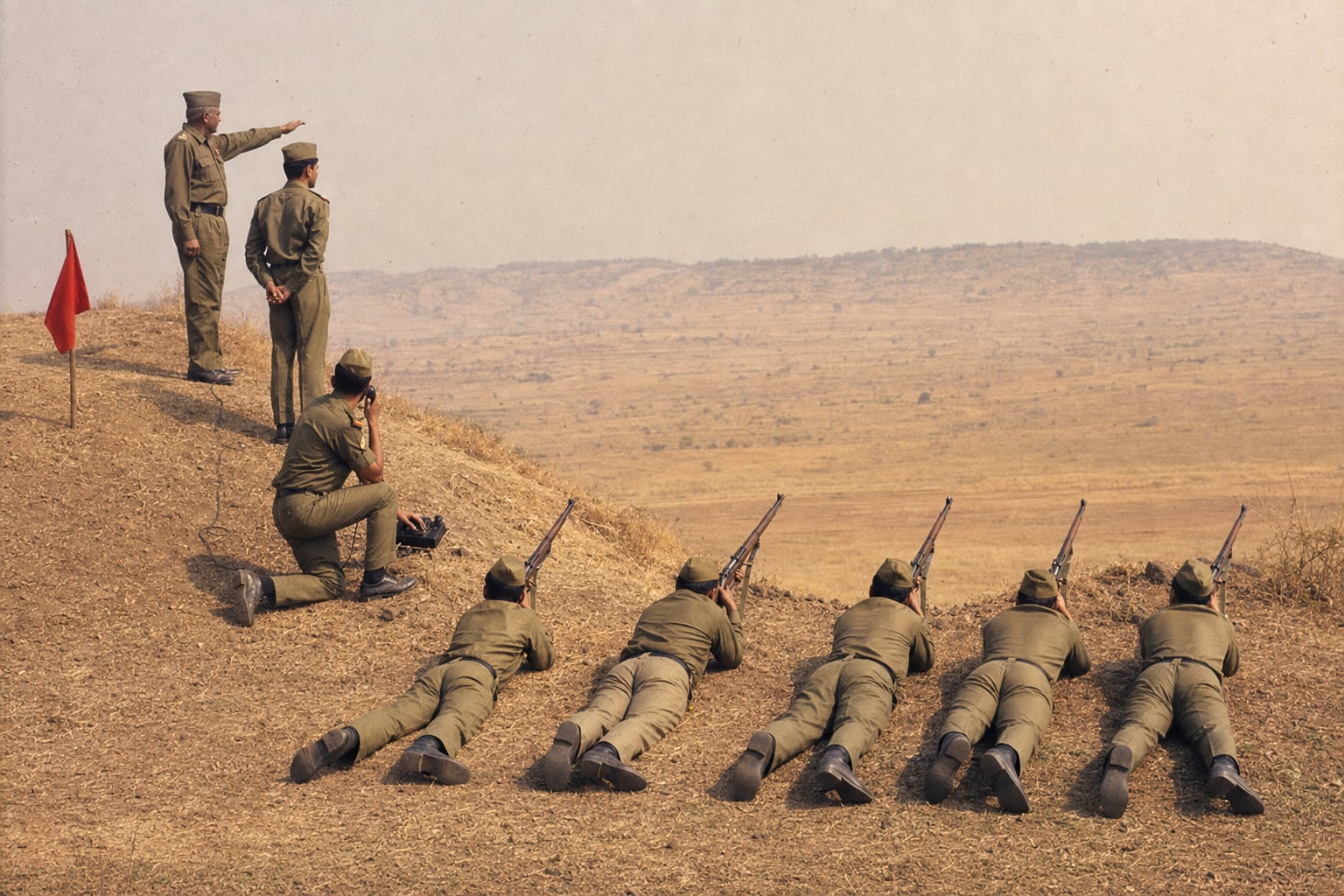
On a dry grassy firing range in hazy daylight, a red range-safety flag flies from a pole while a row of khaki-clad soldiers lie prone with their rifles raised to a calculated firing angle toward the empty distance, two men stand at the crest of a low hillock with the instructor pointing out a direction, and a third kneels on the slope pressing a field-telephone handset to his ear.
Plate IIa peacetime drill; the calculated firing angle reaches the prone line only through the man kneeling on the slope.
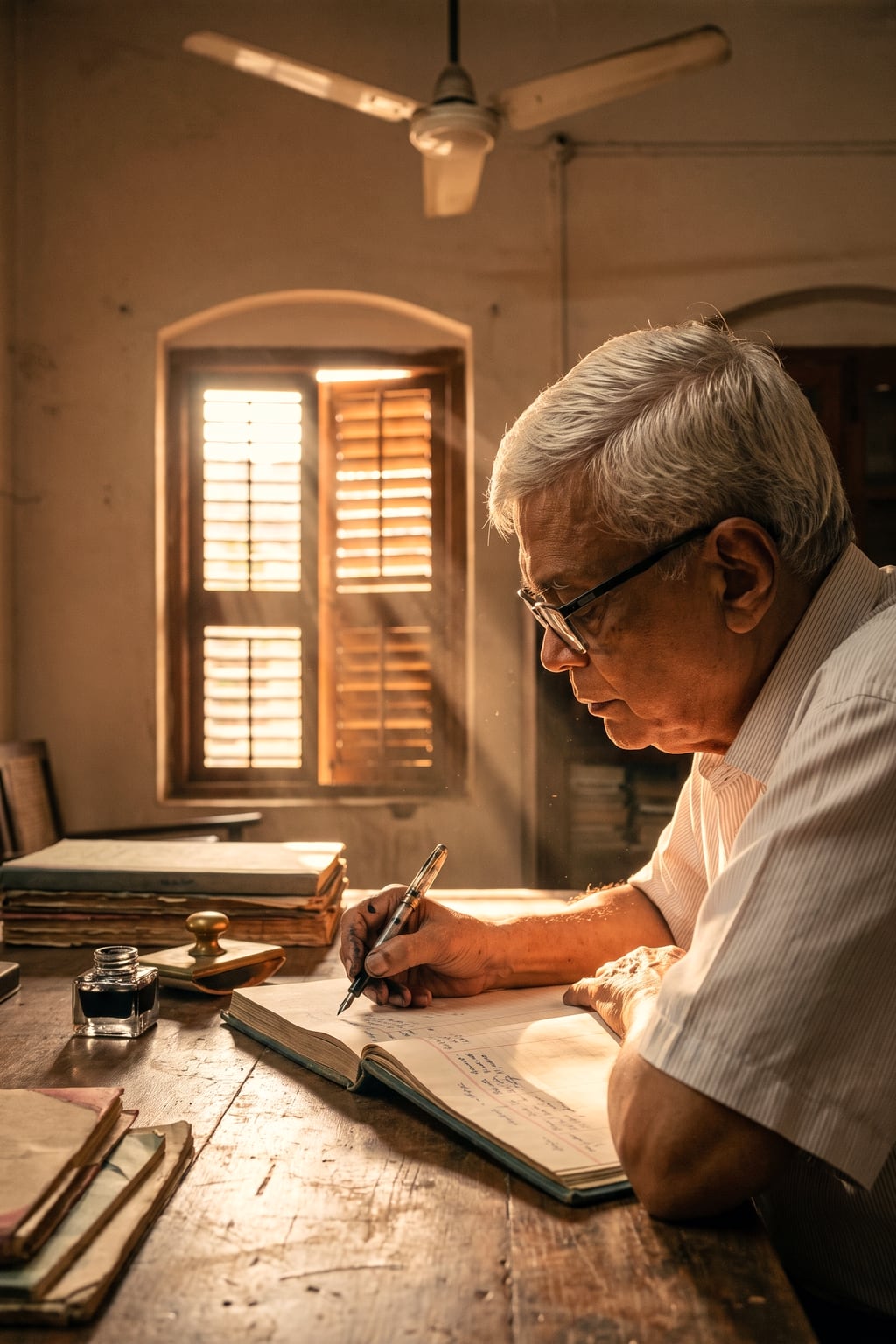
Seen from the side in warm striped afternoon light, an elderly white-haired bespectacled man sits in profile at a wooden desk, his fountain pen inking columns of figures in a large open cloth-bound ledger, more ledgers stacked beside a glass inkwell at his elbow, a tall wooden louvred window rising behind him.
Plate IIIthe columns filled by fountain pen, the ledgers stacked, not a calculator in the room.
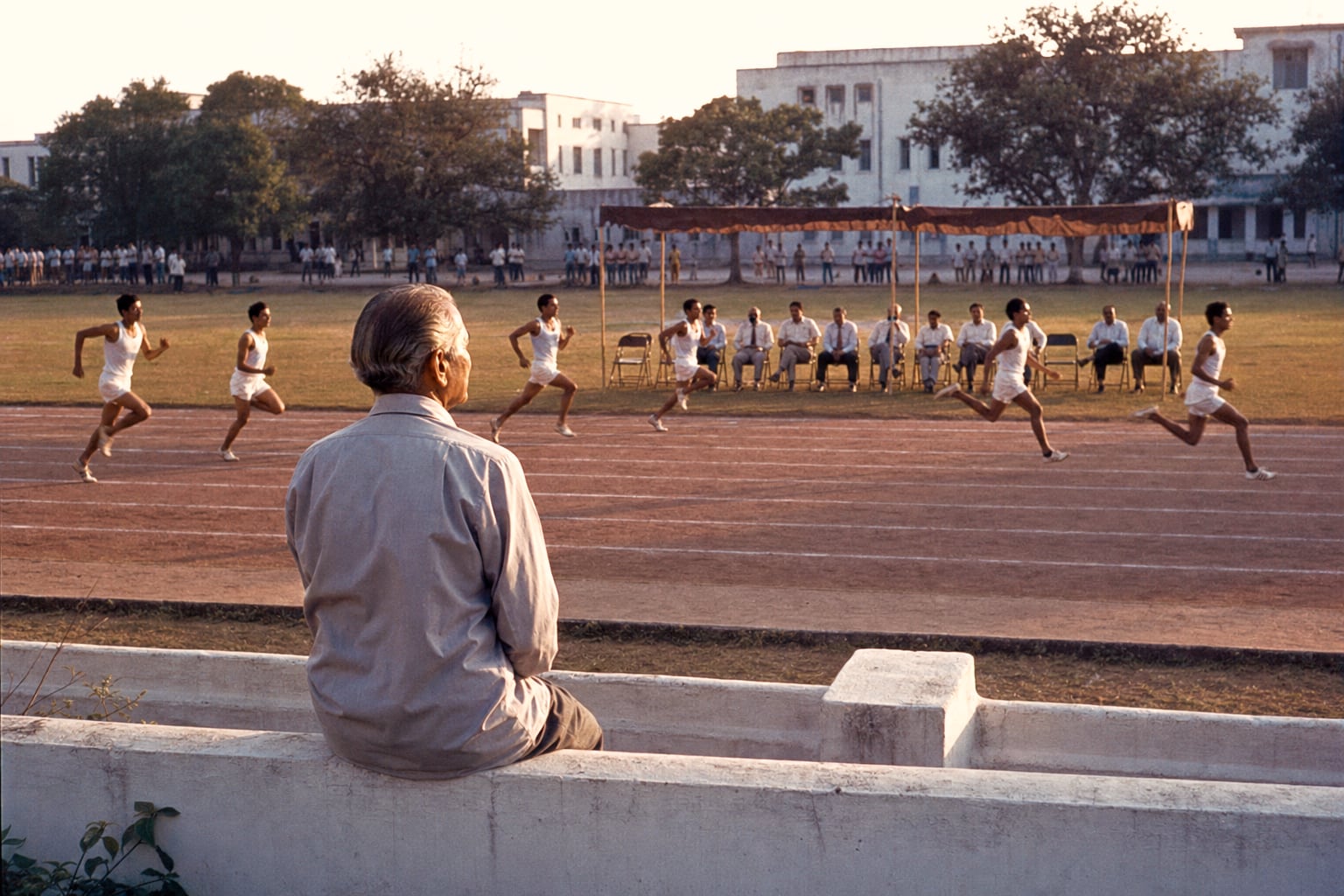
Seen from behind, a lean, slightly built elderly man with grey hair combed straight back sits alone on a low whitewashed wall in a light grey shirt, watching a sprint race pass left to right along the lanes of a red cinder track; beyond the far edge a long row of masters and officials sits beneath a shamiana awning facing the track, students stand in knots on the grass, and a pale college building rises among tall trees in late golden light.
Plate Ithe wizard of hockey, sitting on the college wall, cuttack, 1969.
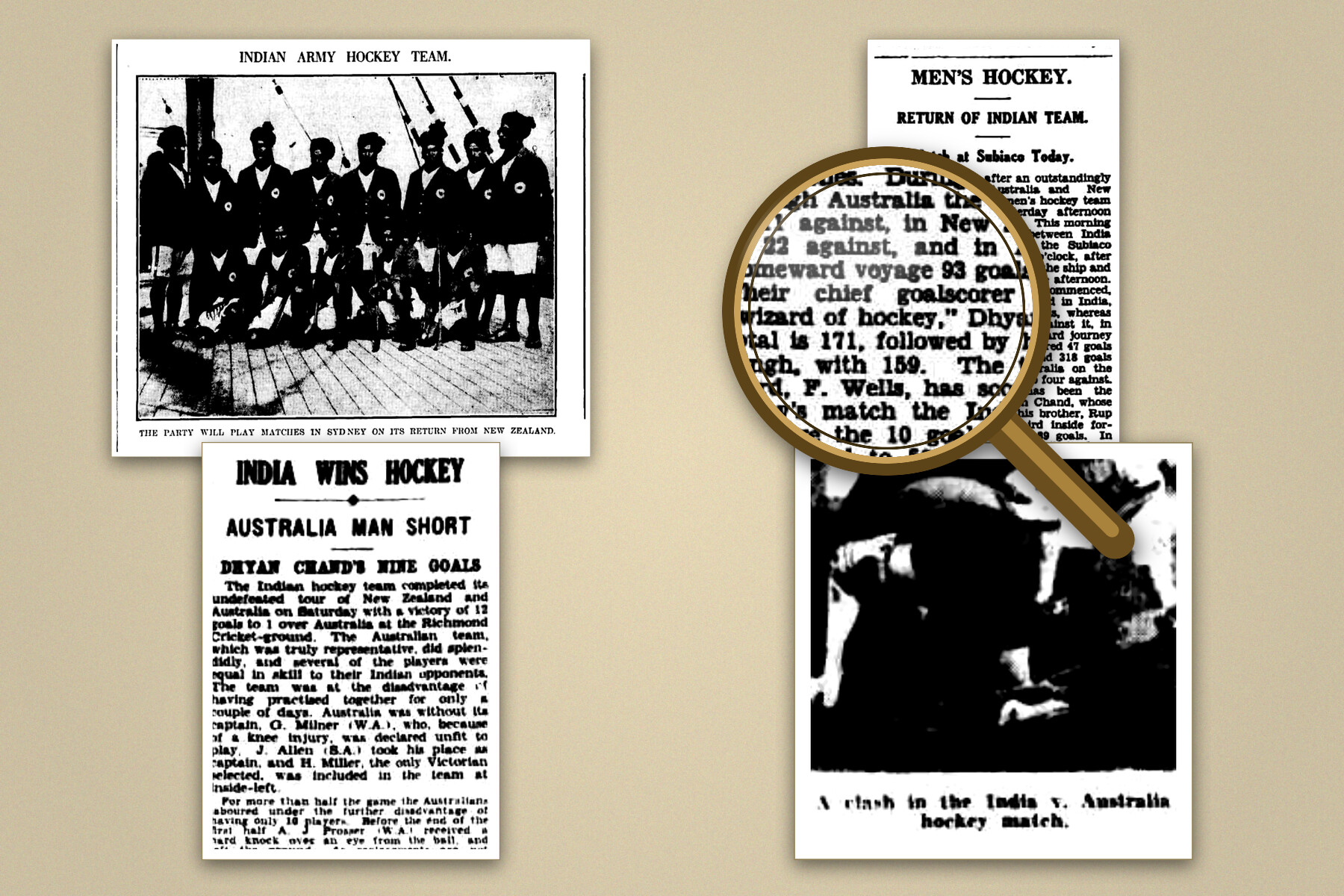
A warm album page of four public-domain Australian newspaper clippings about the touring all-India hockey team. A 1926 group photograph is headed "Indian Army Hockey Team," the players in blazers on a ship's deck. A 1935 report headed "Men's Hockey — Return of Indian Team" calls Dhyan Chand "the wizard of hockey" and records the side scoring 490 goals to 39 across the tour. A bold three-deck headline reads "India Wins Hockey — Australia Man Short — Dhyan Chand's Nine Goals." A fourth clipping is a match-action photograph captioned "A clash in the India v. Australia hockey match." A magnifying glass laid over the report enlarges the words "wizard of hockey."
Plate IIthe wizard of hockey in the world's press — australian newspapers on the touring indian team, 1926 and 1935.
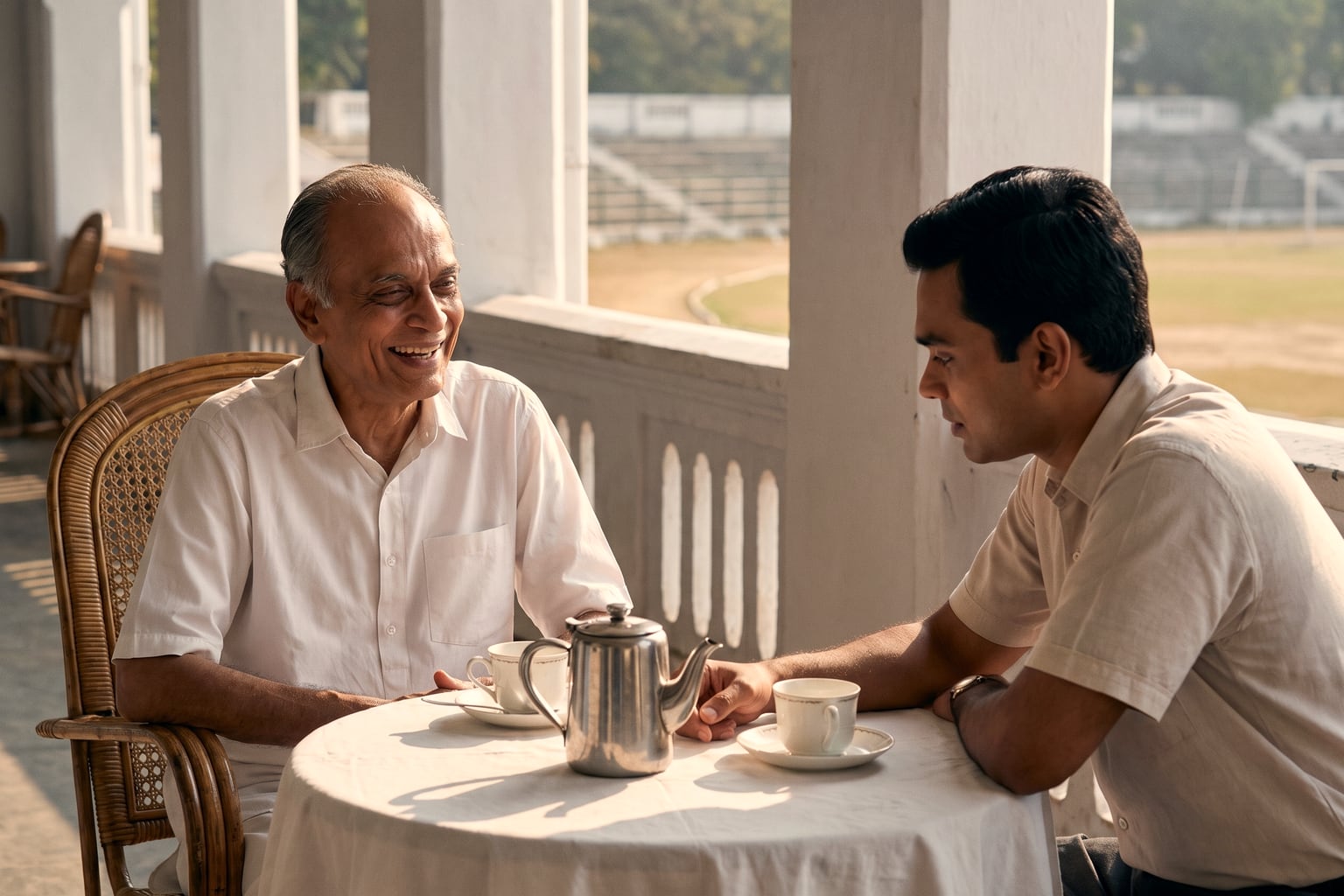
On a bright stadium verandah, a lean elderly man with grey hair combed straight back laughs in a cane armchair, one hand resting near his teacup; across a small round table with a white cloth, a steel teapot and two white cups, a dark-haired young man in a pale shirt leans forward listening, his face in profile; the empty stadium ground and white railings stretch beyond, wicker chairs at the far end of the verandah.
Plate IIImorning tea at the barabati stadium guest house.
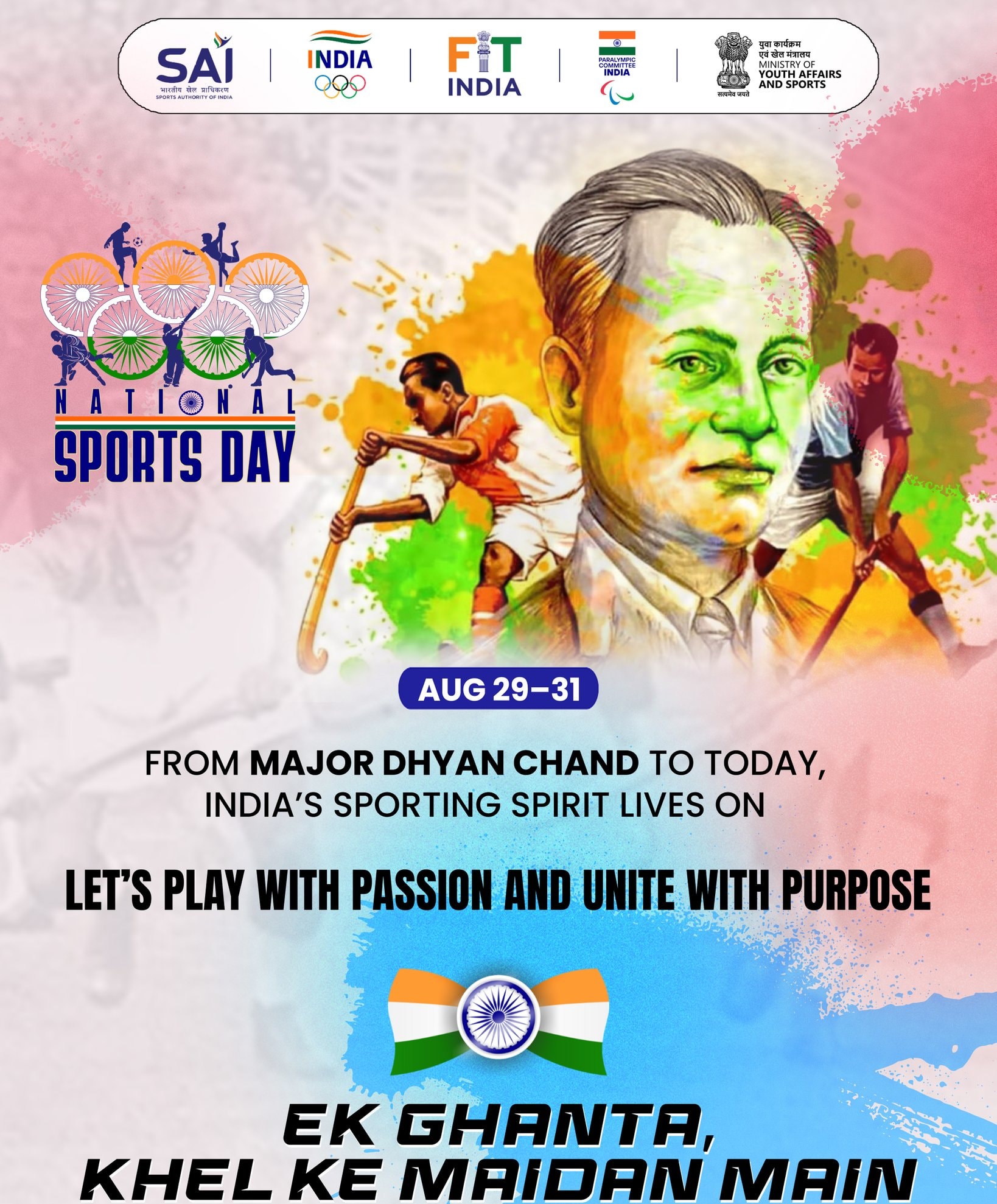
A bright modern tricolour campaign poster for National Sports Day, 29–31 August. Across the top runs a row of official emblems — the Sports Authority of India, the Indian Olympic Association, Fit India, the Paralympic Committee of India, and the Ministry of Youth Affairs and Sports. Below, a stylised portrait of Dhyan Chand's face is painted in the saffron, white and green of the Indian flag; around it silhouetted athletes run and play hockey, and a National Sports Day emblem of interlocked cycle wheels sits at the left. The lettering reads "From Major Dhyan Chand to today, India's sporting spirit lives on", "Let's play with passion and unite with purpose", and, largest, the Hindi slogan "Ek Ghanta, Khel Ke Maidan Main".
Plate IVthe 2025 national sports day campaign, built around the wizard it now celebrates.
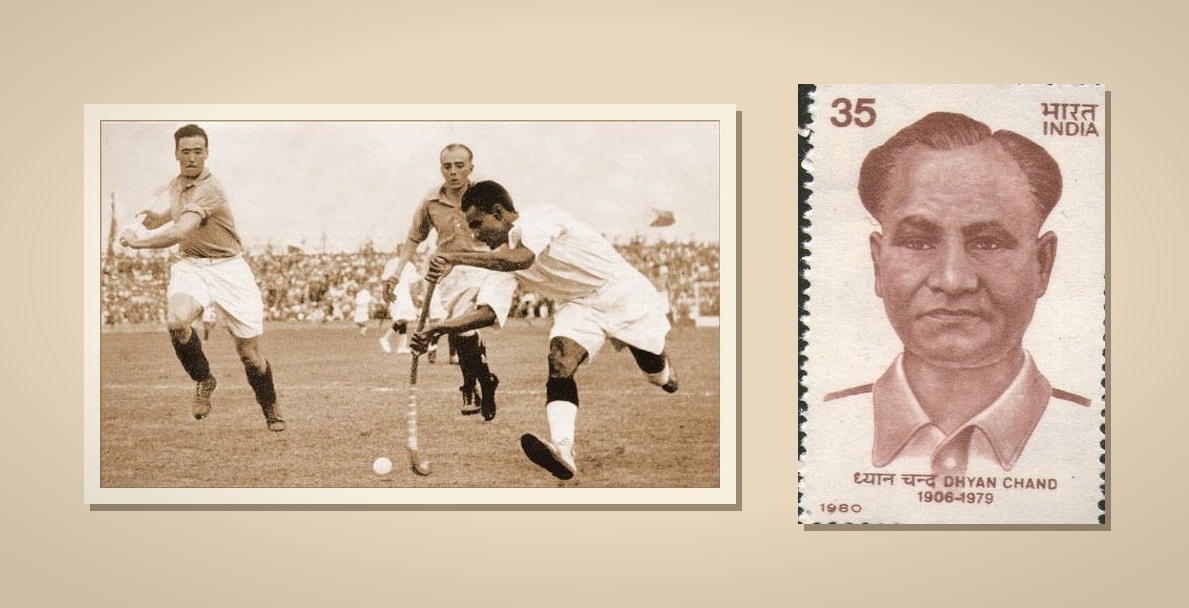
Two sepia archival pieces on an aged cream ground. On the left, a bordered black-and-white press photograph from the 1936 Berlin Olympic hockey semi-final — Dhyan Chand, dark-jerseyed, bent low over the ball with his stick, driving past a lighter-shirted defender, a packed stadium behind. On the right, smaller, the 1980 Indian commemorative postage stamp — denomination 35, lettered "भारत / INDIA", an engraved portrait of Dhyan Chand in a soft collar, "ध्यान चन्द DHYAN CHAND", "1906–1979" and "1980" — its perforated edges intact.
Plate Vthe wizard in the 1936 berlin semi-final, and the 35-paise stamp india post issued in his memory, 1980.
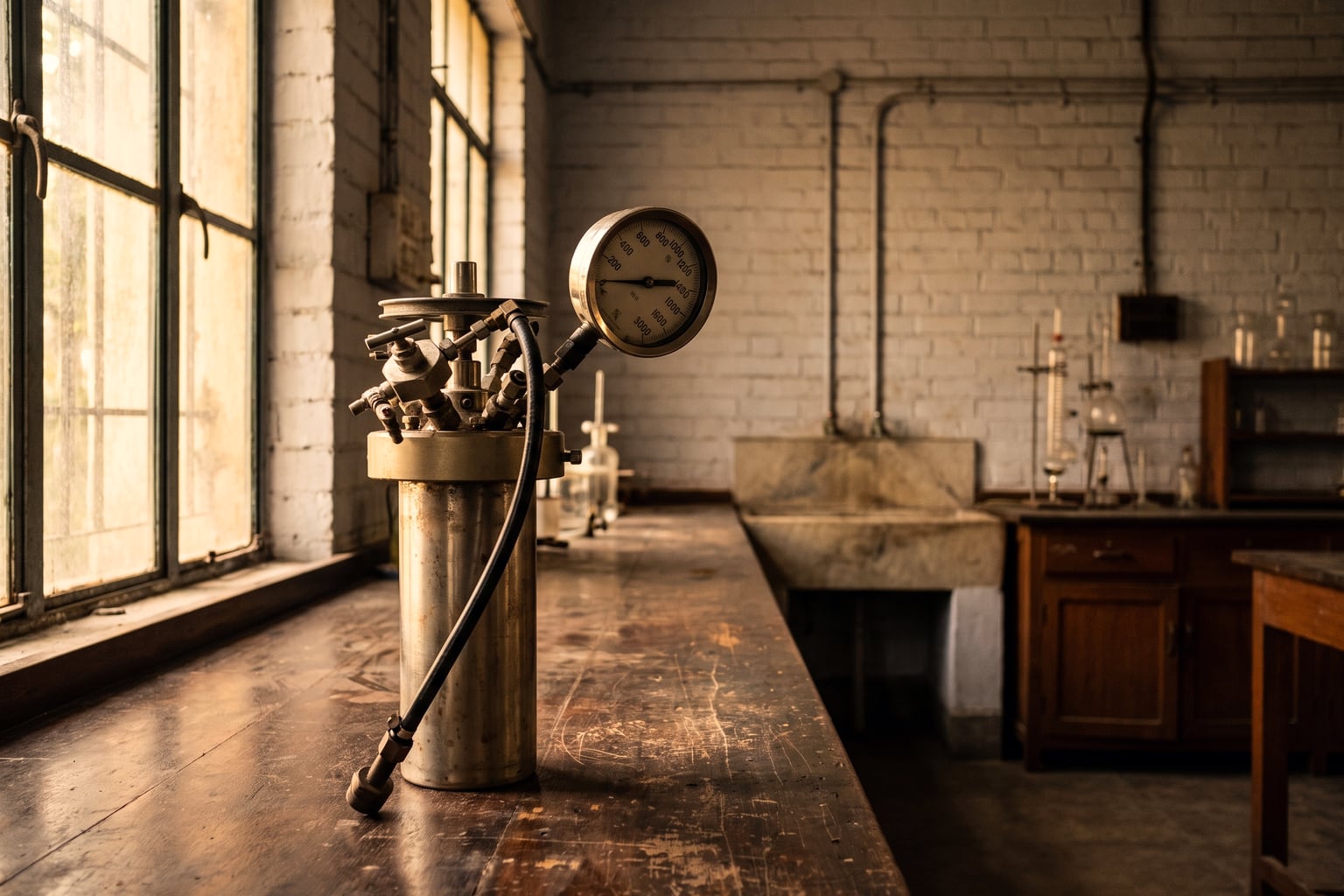
A small high-pressure reactor standing on a scarred dark wooden laboratory bench beside a tall window, in an otherwise empty room. It is a plain steel cylinder about the height of a forearm, its circular head clamped down by a ring of bolts around a raised flange, with a small spoked handwheel lying flat on top and a cluster of little valves and unions beside it. One large round pressure gauge stands up on a bracket to the right of the head, and a black flexible hose loops down from the head to a fitting at the foot of the vessel. Behind it, out of focus, are the rest of the bench, a long stone sink, glassware on a wooden dresser, whitewashed brick walls and an overhead run of pipe. Nobody is in the room.
Plate Ikharagpur, a sunday morning: the reactor Purohit built, before the trial.
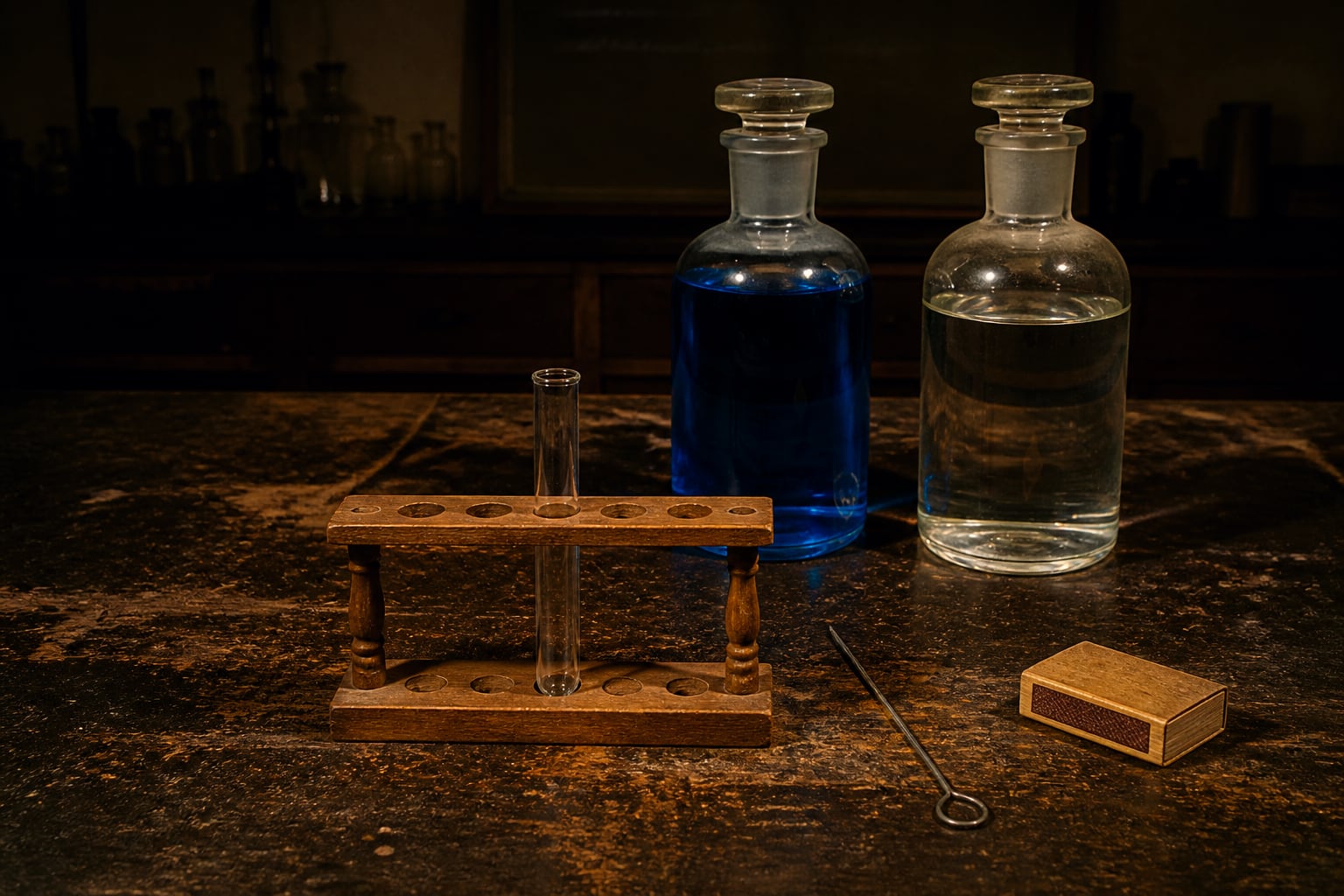
A dark laboratory bench at night, lit low from one side. Two clear glass reagent bottles with heavy ground-glass stoppers stand together at the back, one holding a deep blue solution, the other a colourless one; neither carries a label of any kind. In front of them a clean empty test tube stands upright in a small wooden rack, with a thin wire ending in a small loop and a plain wooden matchbox lying on the bench beside it. The bench top is dark and scarred; behind, barely lit, stands a shelf of bottles. Nothing is mixed and nothing has reacted.
Plate IIthe reagent CK came for, late in the evening.
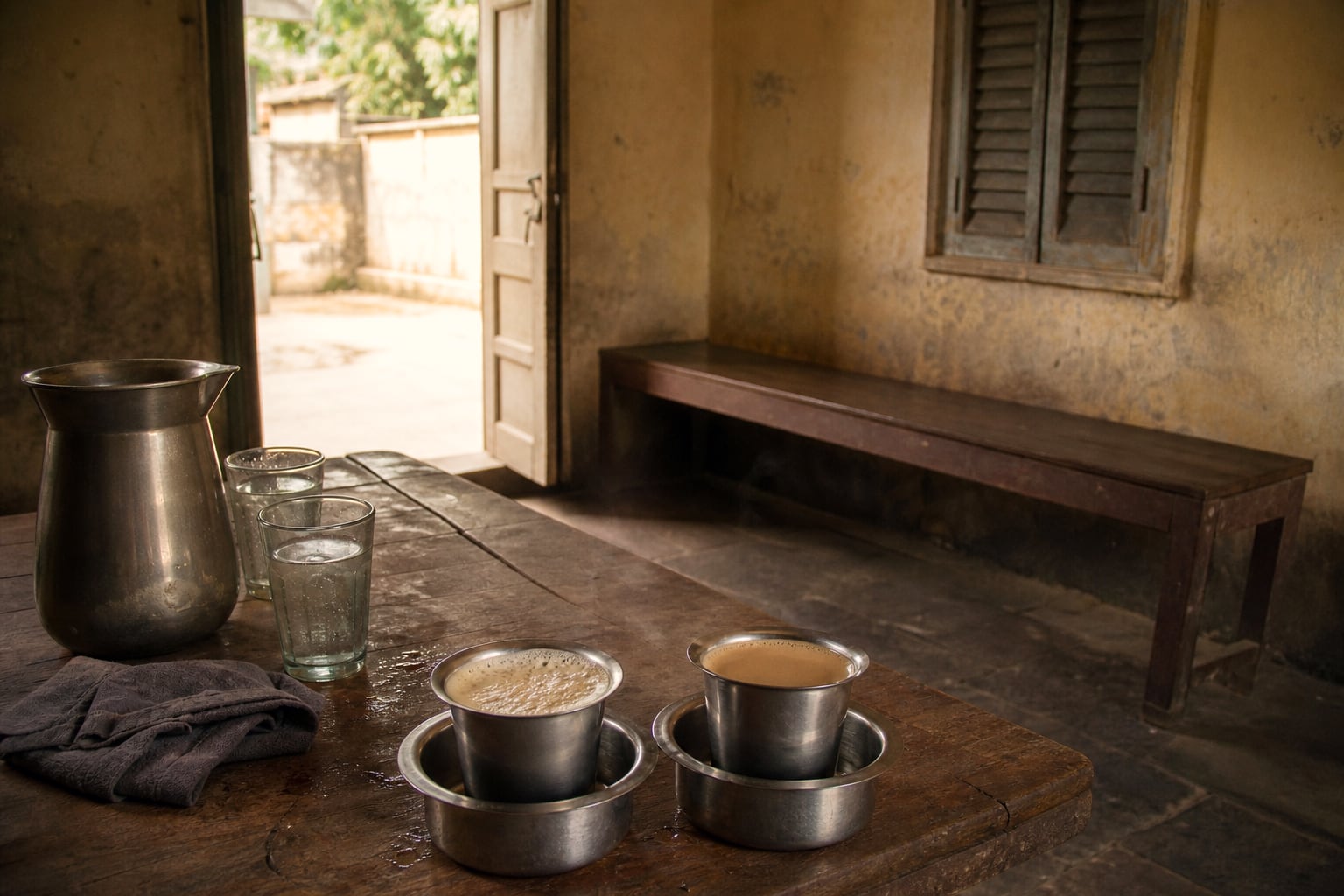
Two sets of steel filter-coffee vessels — a tumbler standing in a deep bowl — on a worn dark wooden table in a small canteen. Both are full, one carrying a head of pale froth, and faint steam rises from them. A dented steel jug and two glass tumblers of water stand behind, and a folded grey cloth lies at the table's edge. Beyond the table a long empty wooden bench stands against a mottled ochre wall below a shuttered window, and an open door gives on to bright daylight, a low wall and green leaves outside. Nobody is in the room.
Plate IIInair's, in a room of his house at Salua, after the trial.
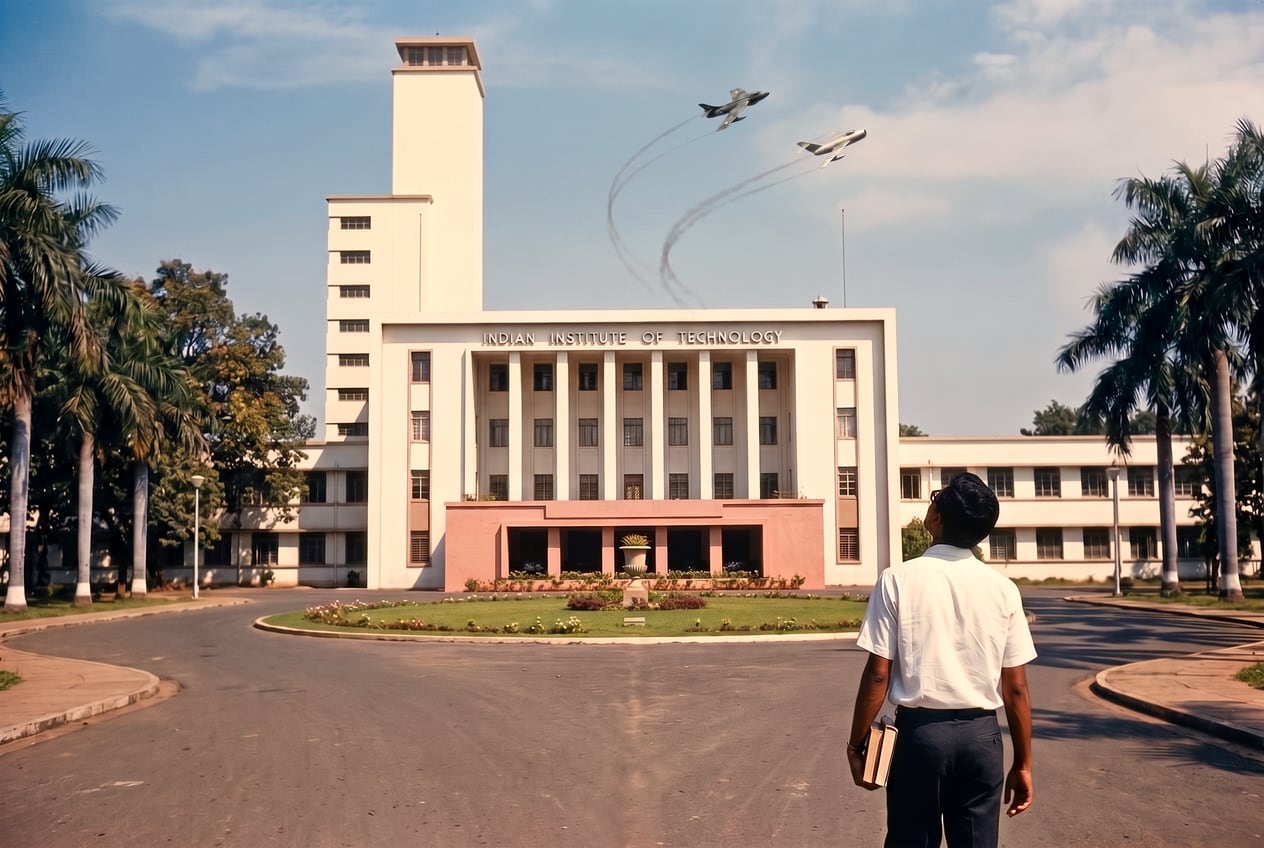
Seen from behind on a dry, empty avenue, a young man in a white collared shirt and dark trousers walks alone with two books under one arm, his head raised to the sky; his face is not visible. Ahead of him stands the main building of the Indian Institute of Technology at Kharagpur — a tall, flat-topped white tower rising beside a broad symmetrical white front of seven slender full-height piers with narrow windows recessed between them, the words INDIAN INSTITUTE OF TECHNOLOGY in spaced metal capitals across the band above them, and a low pink-faced entrance porch beneath. A circular lawn with an ornamental urn at its centre lies before it and the road curves around, with tall palms at either side. Small and high above the building, two swept-wing jet fighters are turning hard, banked over with one on the other's tail — the chasing aircraft dark, the chased one bare silver — their thin smoke trails curving and looping across the sky behind them.
Plate Ione jet in furious pursuit of another, over the main building. kharagpur, 7 september 1965.
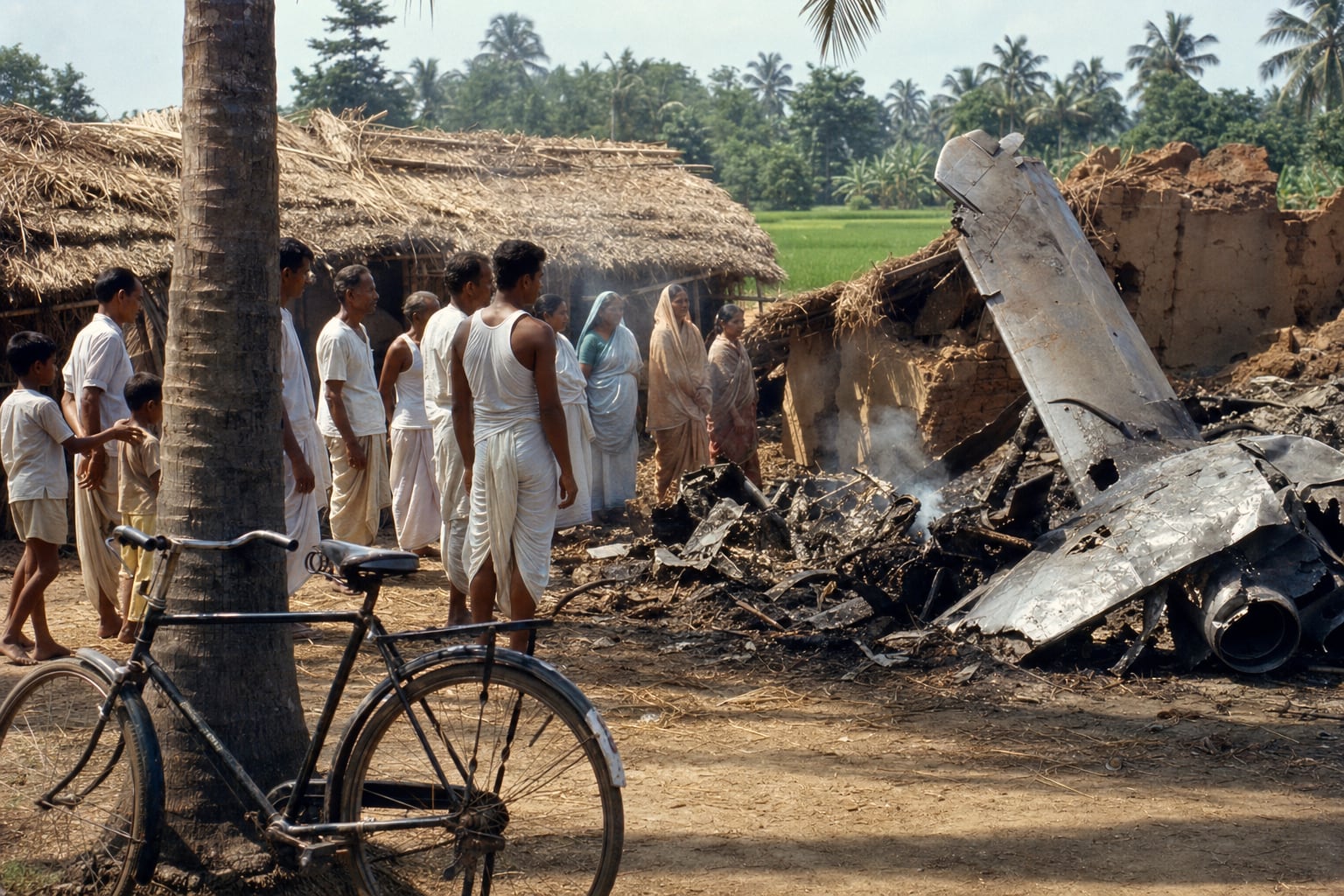
In a village of thatched mud-walled huts under flat daylight, the scorched wreckage of a jet fighter lies in the ruins of a burnt-out hut — a tall dented tail fin standing upright out of a heap of twisted blackened metal, a crumpled fuselage and an exhaust nozzle beyond it, thin smoke still rising. A line of villagers, men in white dhotis and vests and women in cotton saris with two small boys among them, stands a few paces off, several of them looking toward the camera; a black roadster bicycle rests against a palm trunk in the foreground, and green paddy and palms lie behind.
Plate IIthe wreckage still smouldering; the bicycle just set down against the palm.
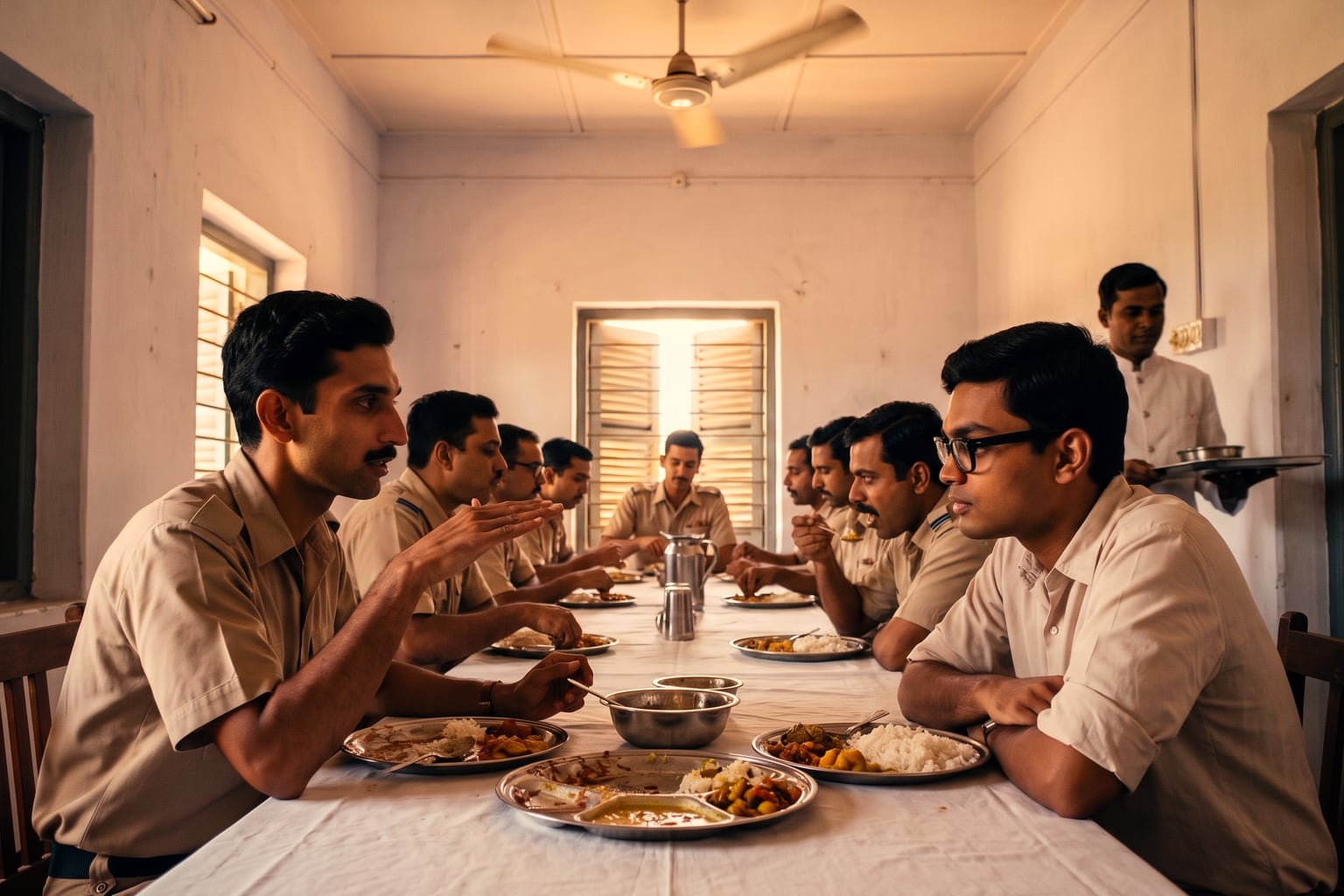
A busy 1960s air-force officers' mess at lunch: a long white-clothed table crowded with officers in khaki shirtsleeves eating rice, dal and vegetables from steel thalis, some talking, some mid-mouthful, and a steward in a white jacket carrying a tray at the back. In the foreground, nearest the camera, two young Indian men face each other across the near end. On the left an officer with a narrow moustache holds one hand raised flat and tilted in the air to show a banked turn, mid-sentence, a spoon still in his other hand; opposite him a bespectacled young man in a pale shirt rests his folded arms on the cloth, listening. A steel water jug stands between them, a ceiling fan turns overhead, and a tall shuttered window lets in the glare behind.
Plate IIIlunch at the station, soon after: the hand held flat and tilted, showing the turn.
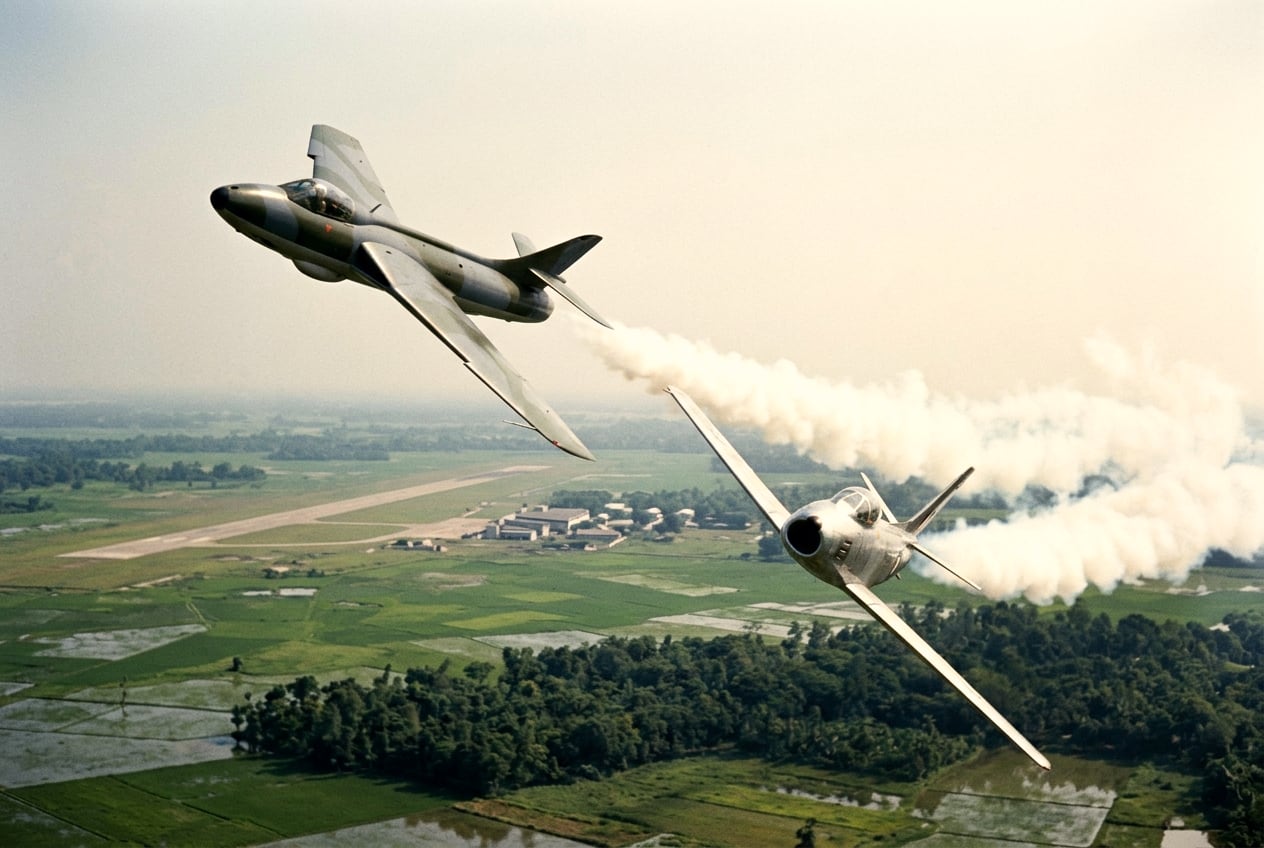
Two single-seat swept-wing jet fighters cross in opposite banks above a patchwork of flooded green paddy fields and woodland, their fuselages forming an X and their noses pointing different ways, each streaming a thick white plume of smoke behind it. The upper aircraft, in green-and-grey camouflage, has a smooth closed nose and air intakes set into its wing roots; the lower one is bare polished metal with a large oval intake forming the open mouth of its nose. A concrete runway with low hangars and dispersal buildings runs across the country beneath them.
Plate IVthe scissors: a series of short turns, slowing with each one, to force him to overshoot.
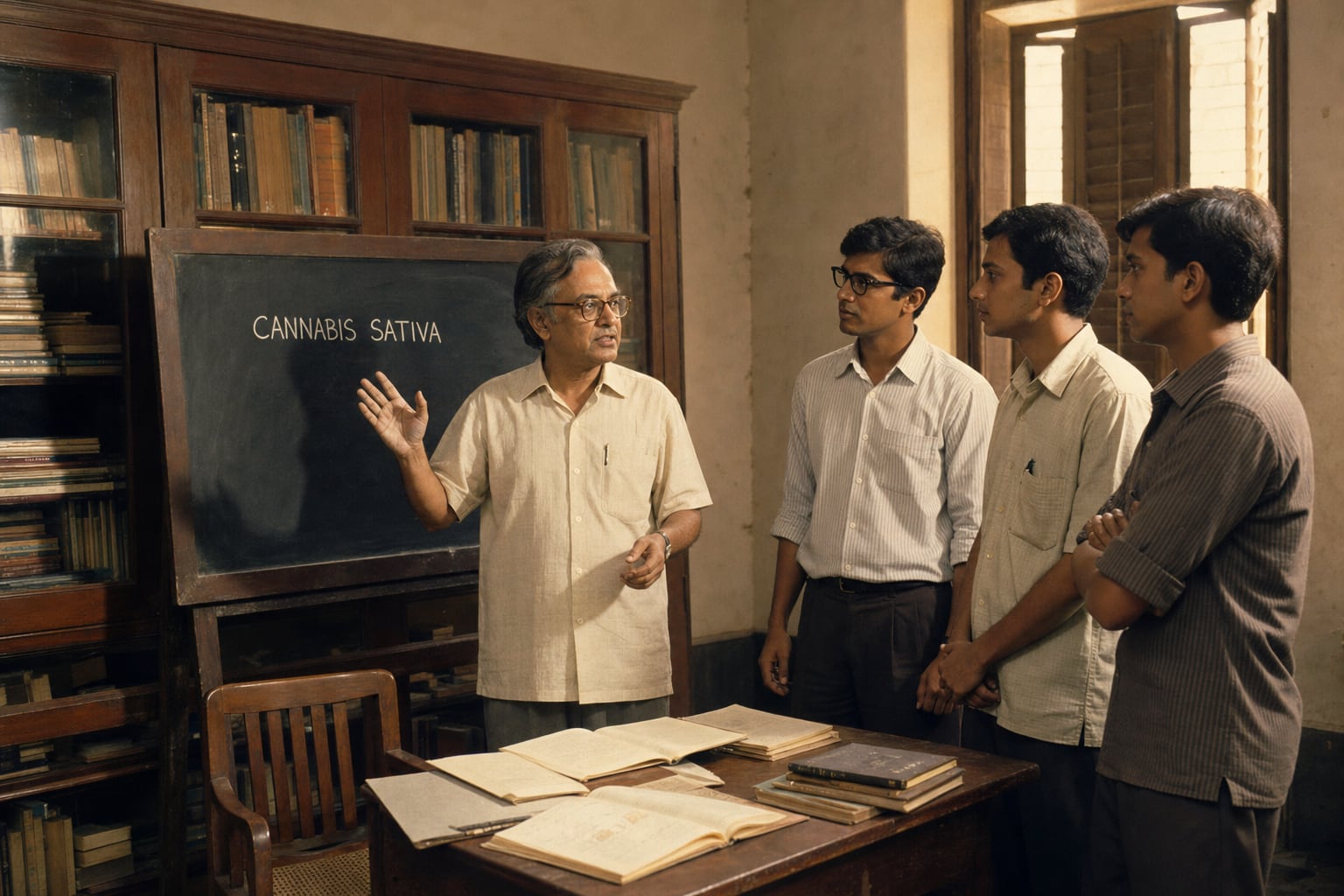
A middle-aged Bengali chemistry professor in wire-rimmed glasses turns from a small black chalkboard reading 'Cannabis sativa', one hand raised mid-explanation, while three young Indian research fellows stand and listen; a cupboard of books rises behind him and his chair and a table of scattered notebooks sit before the board in a sunlit 1964 university chemistry room.
Plate I'cannabis sativa' in chalk; the professor turns, chalk on his fingers.
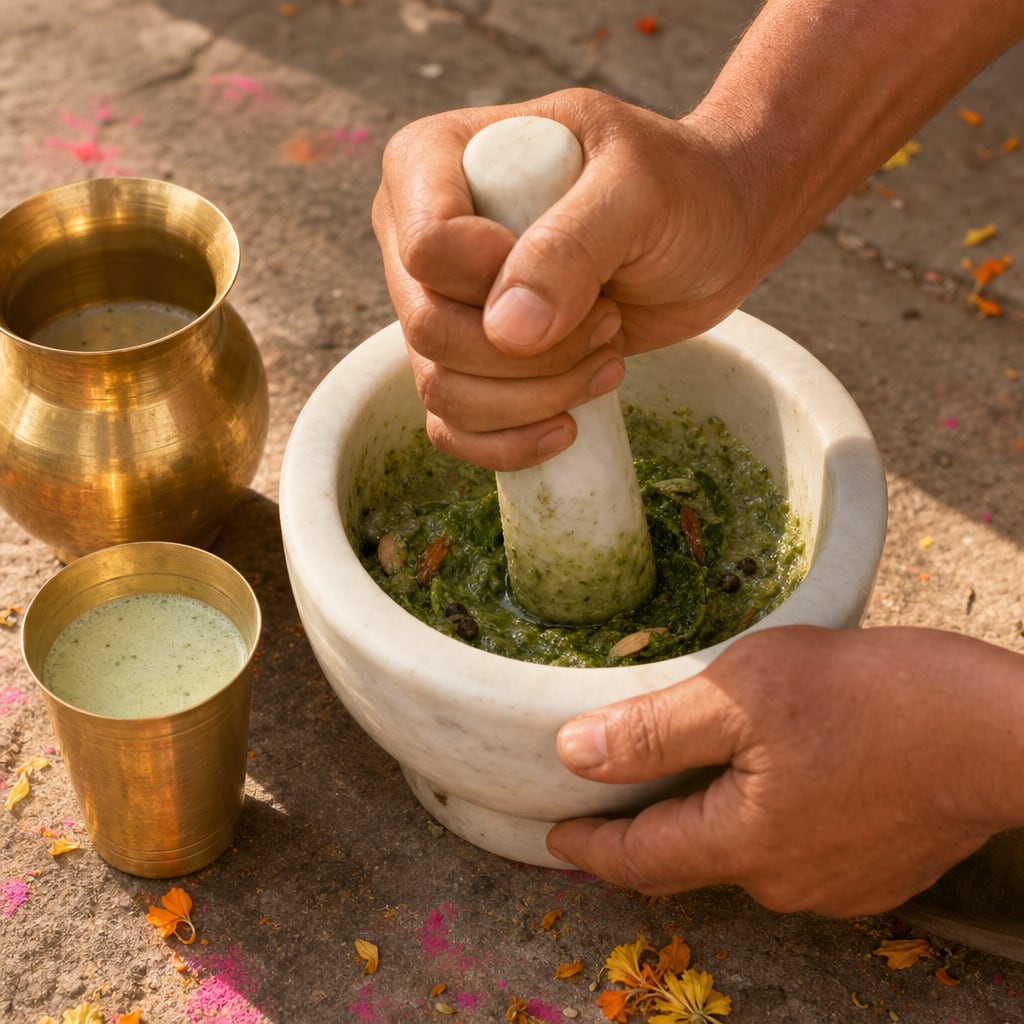
One hand steadies a white marble mortar by its rim while the other works a white marble pestle, grinding fresh green Cannabis sativa (bhang) leaves with soaked almonds and a splash of milk into a paste, beside a brass lota and tumbler of pale-green spiced milk, with faint pink and yellow gulal smears and marigold petals on a stone courtyard floor.
Plate IIholi morning: one hand steadies the white marble mortar while the other works the pestle, grinding the thandai.
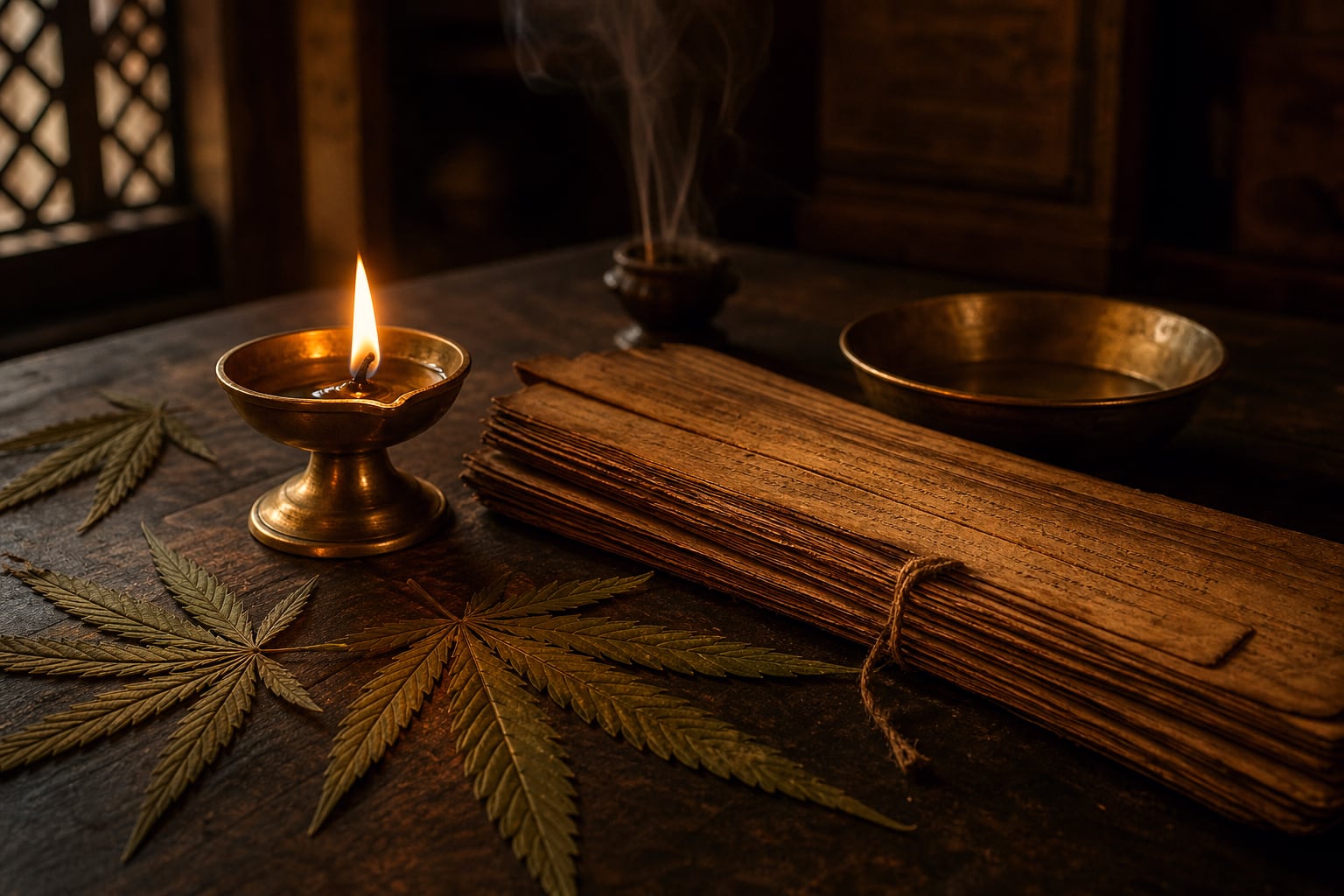
A small lit brass oil lamp glows on a dark wooden table beside a few dried cannabis leaves and an aged, frayed palm-leaf manuscript bundle, warm lamplight pooling around them and falling to shadow at the edges.
Plate IIIan oil lamp, dried cannabis leaves and a worn palm-leaf manuscript in the evening light.
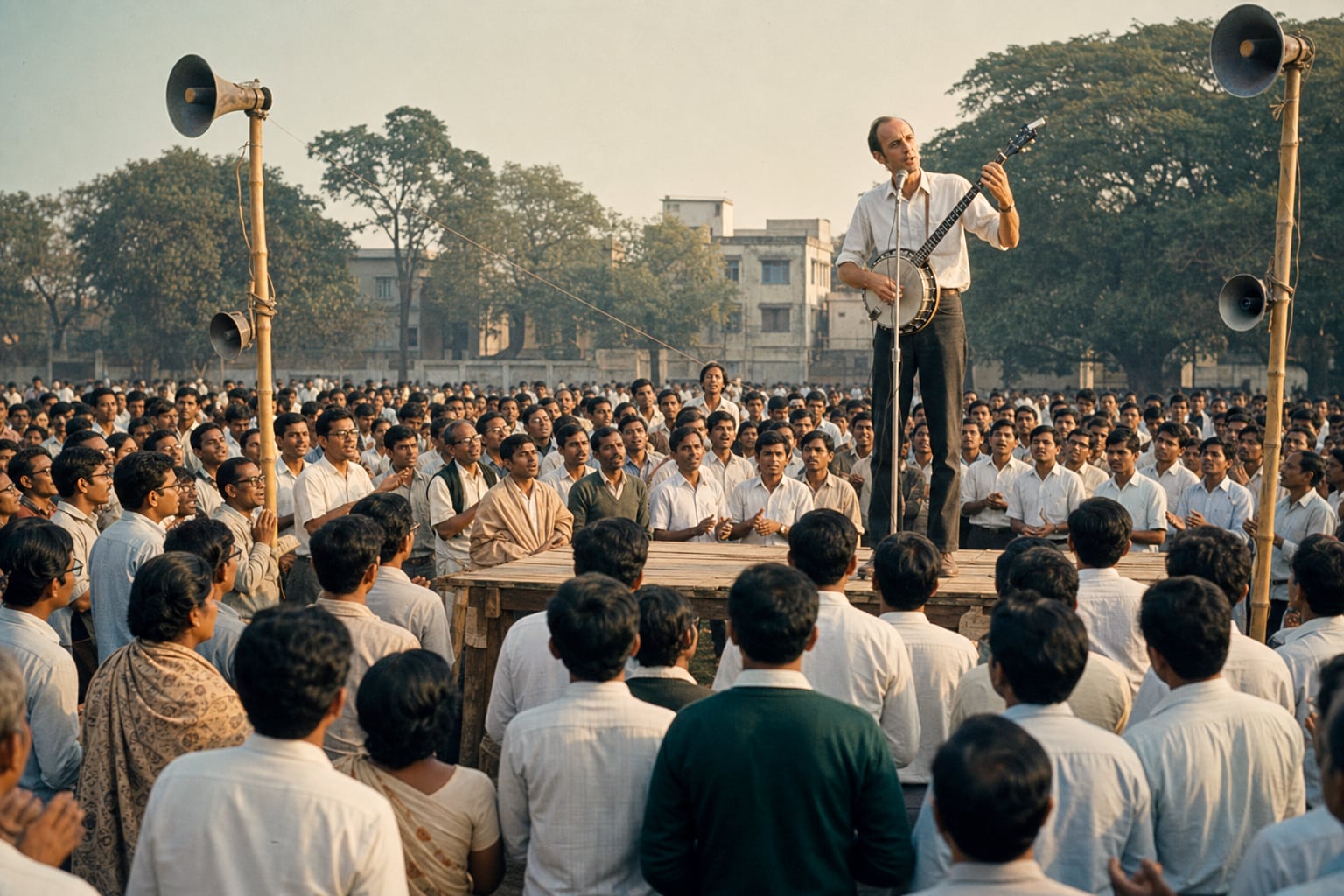
Seen from within a dense crowd on an open maidan in soft winter light, a tall, lanky man with receding hair, in a plain shirt with rolled sleeves, stands on a low makeshift stage playing a long-necked banjo at a single microphone; loudspeaker horns are lashed to bamboo poles, young men in white shirts and a few older listeners press close around the stage, some clapping time, and the trees and low buildings of 1960s Calcutta close the scene.
Plate Ian american with a long-necked banjo, park circus maidan, december 1963.
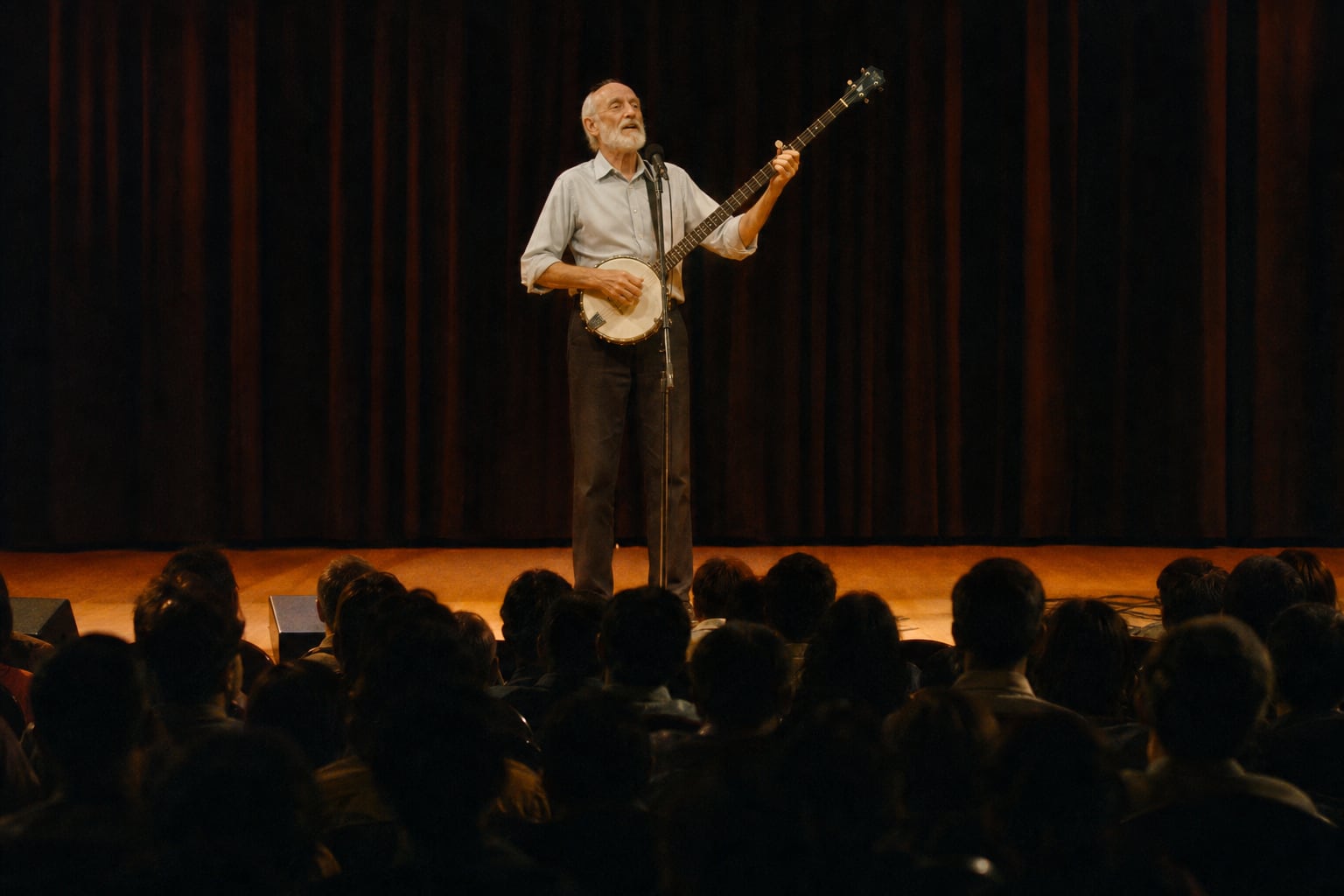
On a warmly lit auditorium stage, a tall, lean elderly man with a bald crown, white hair at the sides and a short white beard stands at a microphone playing a long-necked banjo, head tilted back mid-song; heavy curtains frame the stage, and in the foreground the dark silhouetted heads of a full Indian audience watch from the rows below.
Plate IIat 77, at the microphone in kala mandir, november 1996.
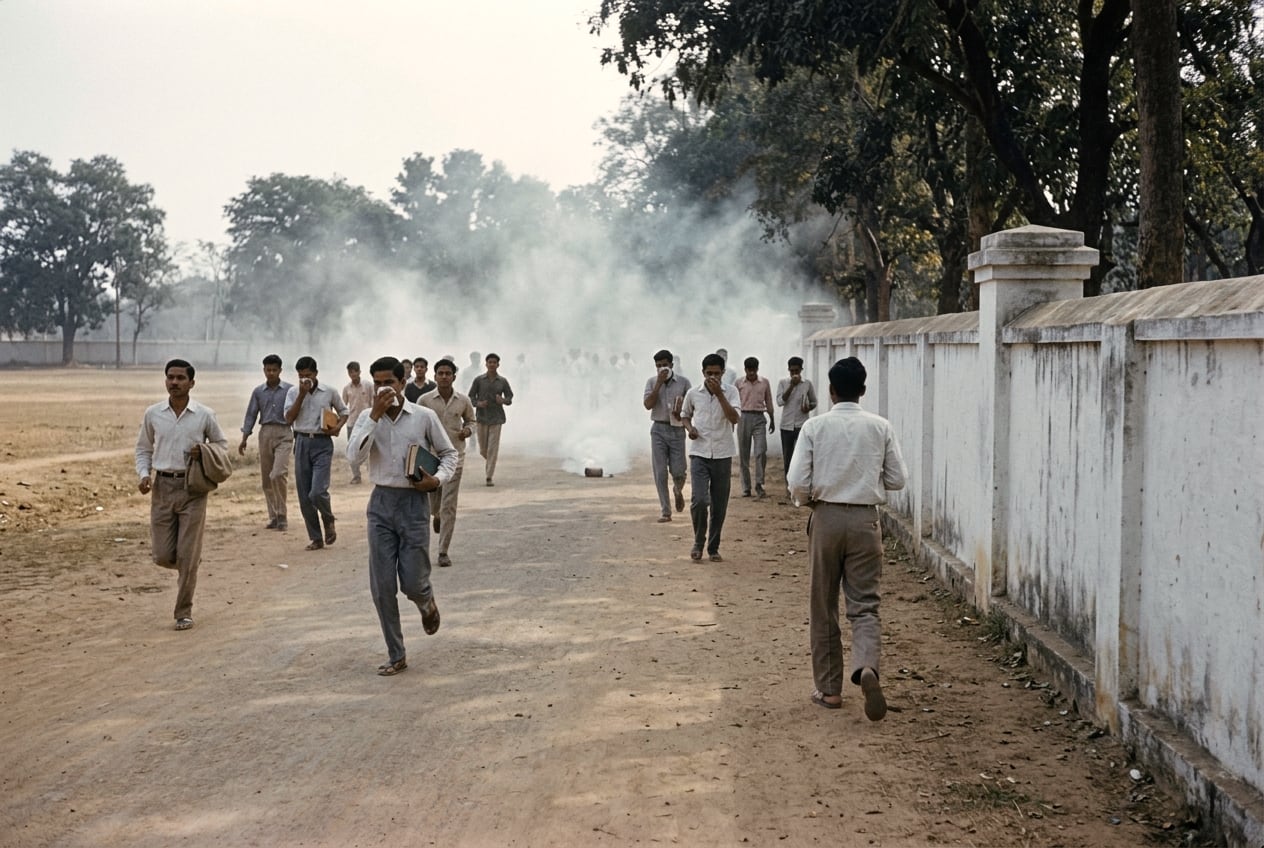
A dusty open road in Cuttack under the flat white light of a January noon. Along the right-hand side runs a low whitewashed boundary wall, waist height and flat-capped with squared piers, receding into the distance with mature trees behind it; the left of the picture is open dusty ground with distant trees and no building on it. In the middle distance a low pall of pale tear-gas smoke drifts across the road, rising from a small canister lying on the ground. Between it and the camera a scattered group of about a dozen young college-age men in full-length trousers and plain shirts hurry and run away from the smoke, spread across the road at different distances; several hold a hand over the nose and mouth, one carries books under an arm and another a cloth bag, and one man nearer the wall is seen from behind. Nobody else is present.
Plate Icuttack, january 1956: the tear gas, and the students running — along the wall opposite the site of the firing.
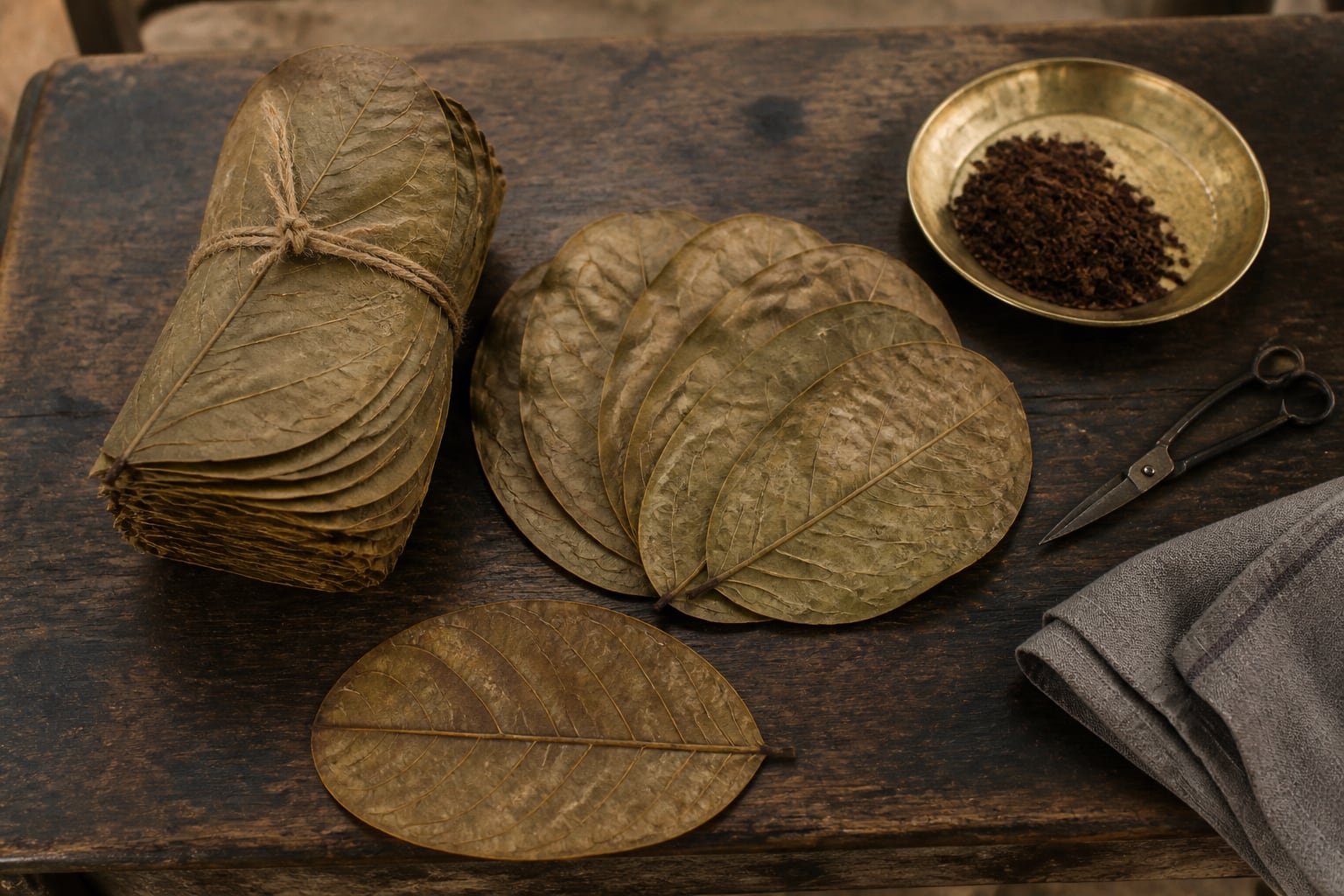
A still life on a worn, dark wooden table in soft daylight. A thick bundle of dried kendu leaves — broad and oval, tanned to a dull golden brown — is tied at the middle with rough jute twine; more loose leaves lie fanned out beside it, and one whole leaf lies flat in the foreground with its veining clear. Behind them a shallow brass dish holds a little coarse dark tobacco flake; a small pair of iron scissors and a folded grey cloth lie to the right, at the edge of the table. Nothing is rolled and nothing is lit.
Plate IIthe leaf the quarrel was about — kendu patara, dried and bundled.
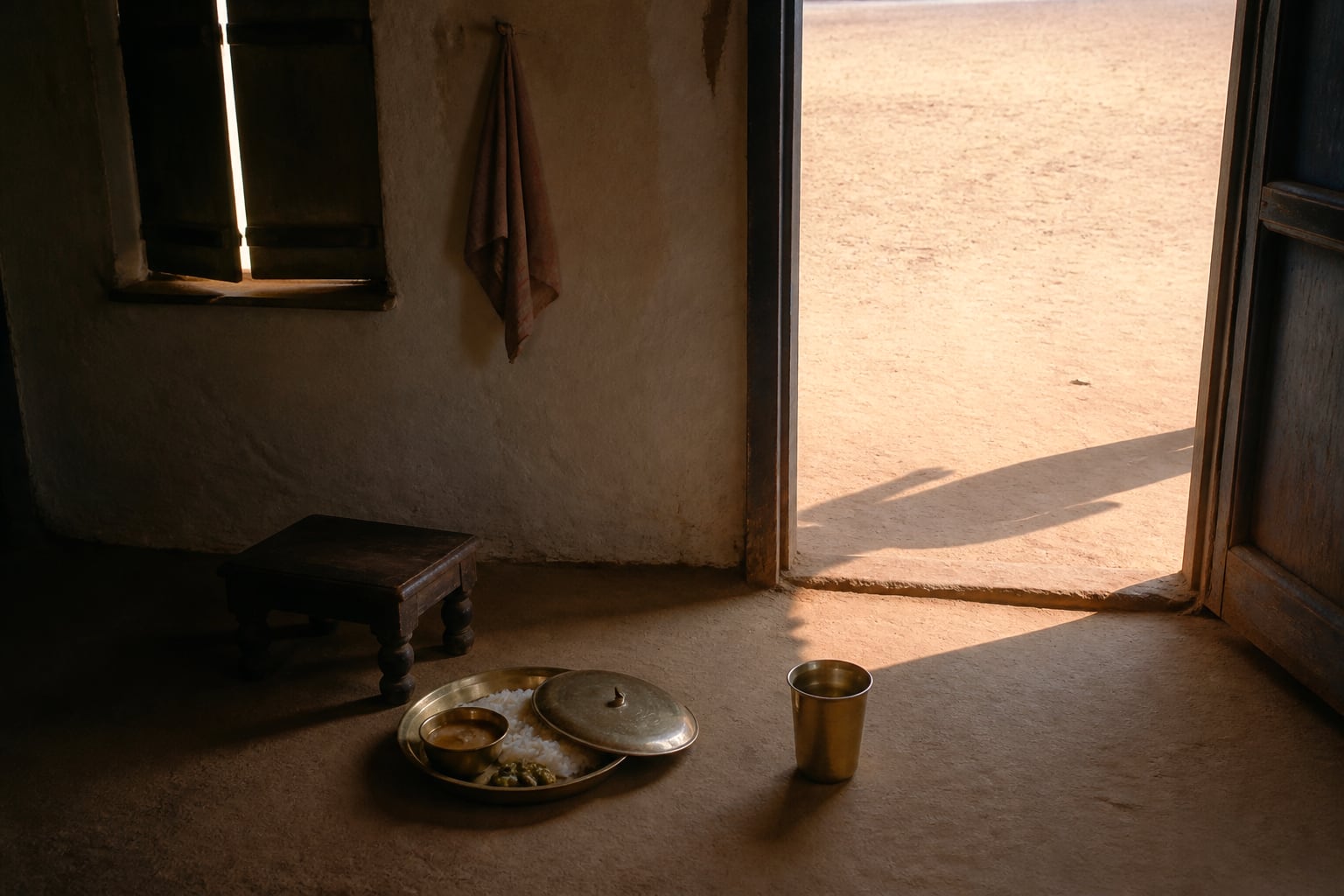
Inside a modest Indian home at midday, seen through an open doorway that gives on to bare, bright, empty sunlit ground. On the earth floor just inside stand a low wooden seat and, set before it, a brass thali of rice with a small bowl of dal on it, half covered by a domed brass lid; a brass tumbler of water stands apart, nearer the door. A cloth hangs on the limewashed wall and a bar of light falls from a shuttered window. The room is empty of people; the only trace of anyone is a figure's long shadow thrown across the ground outside the threshold.
Plate IIIthe noon meal, waiting.